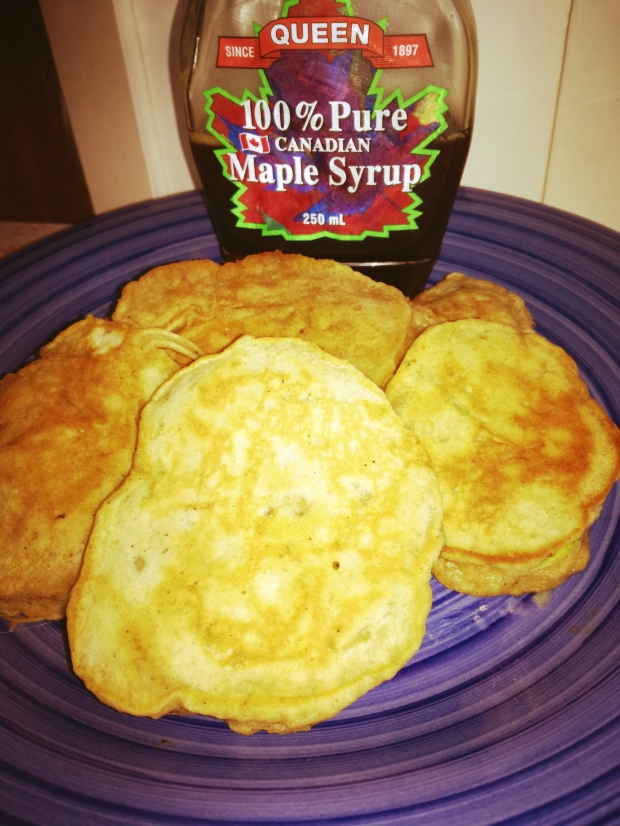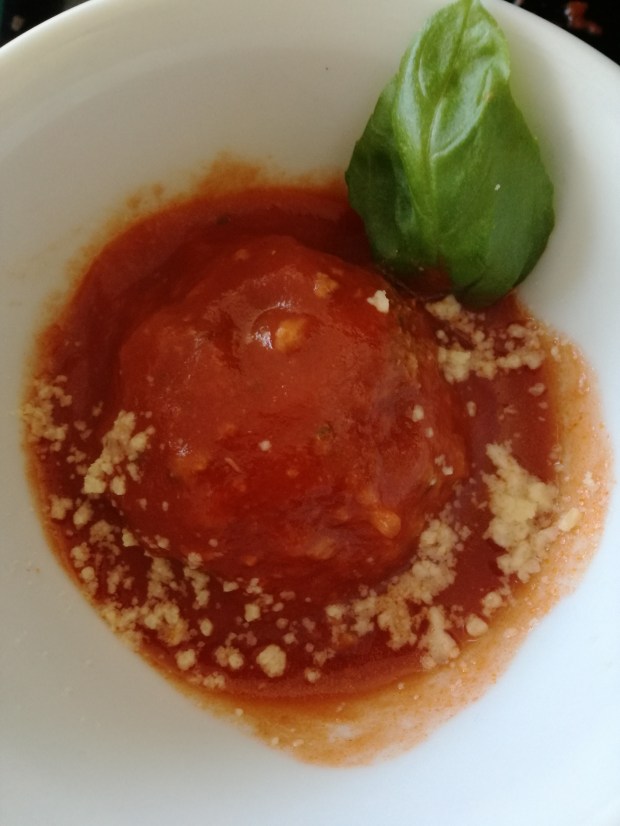
Tender and delicious Italian American meatballs in tomato passata

Gluten Free Italian American Meatballs in Pasta Sauce

Gluten Free Italian American Meatballs in Pasta Sauce

I haven’t made meatballs in the past; for some reason I thought they would be really tricky to make. I found these to be super easy and have now made them both in passata and oven baked. The two cooking styles create different textures – if you cook in passata they will have a softer, moister mouthfeel whereas oven baked meatballs will be drier and denser (good to dip in an accompanying sauce). Both ways are great!

This recipe will make a big batch of meatballs so feel free to halve it if desired (or to cook half in passata and half in the oven to enjoy both styles!)

Ingredients

Meatballs

  • 150g breadcrumbs / gluten-free breadcrumbs / cooked quinoa
  • 3/4c milk / almond or rice milk
  • 600g beef mince (ground beef)
  • 1 small finely chopped onion
  • Optional: 1/2c parmesan cheese (powder or finely grated)
  • 1T ground chia seeds
  • Salt & pepper
  • Parsley (dried or finely chopped fresh)
  • Chives (dried or finely chopped fresh)
  • Garlic (dried granules or crushed fresh garlic)

Tomato Passata

  • 2x 700g jar tomato passata
  • Fresh basil (finely chopped)
  • Sugar
  • Salt & Pepper

Allergies: gluten free*, dairy free*, egg free, soy free, nut free.

Directions

  1. Soak the breadcrumbs in the milk until the liquid has been absorbed.
    • If you’re using cooked quinoa instead: put the quinoa in the mixing bowl for the next step and add the milk after the other ingredients are roughly combined (you may not need to add all the milk).
    • You can do Steps 2 & 3 while the breadcrumbs are soaking. The pasta sauce will then simmer while you carry on making the meatballs.
  2. In a large pot (or electric wok), mix the tomato passata, basil, sugar, salt, pepper to your taste.
  3. Bring the sauce to a boil over a medium heat and then reduce to simmer.
  4. In a large mixing bowl, add all of the meatball ingredients (including the soaked breadcrumbs). Mix until combined. The mixture will be a little sticky but should be thick and not overly wet.
  5. Lightly oil your hands and roll meatballs; I like to do lots of small ones (approx. 2T of meat mix). You can sit the rolled meatballs on a sheet of baking paper or a lightly oiled plate until you’re ready to cook them.
  6. Add the meatballs to the simmering sauce.
  7. Give a gentle stir after 5 minutes. Cover and simmer for another 35 minutes.
  8. Remove the lid and simmer for another 5 minutes.
  9. Serve with spaghetti, gluten-free pasta, or rice noodles.
 

Gluten Free Berry Muffins

Gluten Free Berry Muffins

Gluten Free Berry Muffins

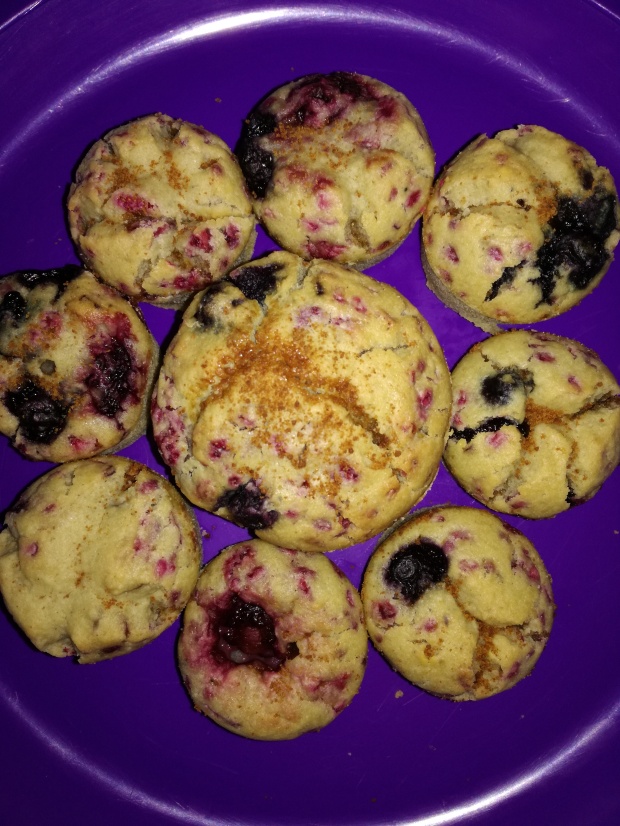
I love experimenting with gluten free flours. This is a different recipe again from the gluten free Vanilla Cupcakes and moist Chocolate Cupcakes. I was really stoked as Miss 2 kept asking for more of the mini ones and her playdate didn’t notice they were gluten free!

Like most gluten free baking, these are best served same (or next day); I free flow the rest in the freezer and pull them out as needed.

Ingredients

Group 1

  • 1 cup hot water
  • 1/2 cup neutral vegetable oil (like Rice Bran oil)
  • 1 egg
  • 1 tsp vanilla
  • Generous pinch ground cinnamon

Group 2

  • 3/4 cup sugar
  • 1 cup superfine white rice flour
  • 1/2 cup garbanzo flour (also called chickpea flour)
  • 1/4 cup oat flour
  • 1T sweet (glutinous) rice flour
  • 1/4 cup cornstarch (cornflour)
  • 1/2 tsp guar gum
  • 1/2 tsp Baking Soda
  • 1/2T Baking Powder
  • 1/2 tsp salt

Other ingredients

  • 1/3 – 1/2 cup frozen berries
    • I recommend raspberries and blueberries.
  • Raw unrefined coconut sugar

Allergies: dairy free, soy free, gluten free, nut free.

Directions

  1. Preheat the oven to 180’C.
  2. Whisk together the ingredients in Group 1. This helps to aerate the mix. You can use a stick blender or I used the food processor (with a plastic mixing attachment, not a metal cutting blade!).
  3. Sift together the ingredients in Group 2.
  4. Mix the combined dry ingredients into the whisked liquid.
  5. Prepare the frozen berries and mix in gently.
    • Raspberries crush really easily into tiny teardrops (which provide a pretty pink speckled effect when baked); blueberries are already a good size; boysenberries are large enough to need cutting in half.
  6. Pour into cupcake / muffin trays.
    • I made 6 large and 12 mini cupcakes.
  7. Preheat the oven to 180’C. The mixture will thicken slightly while the oven heats.
    • The mix will appear very runny compared to a gluten mix – the rice flour and cornstarch will cause it to thicken as it cooks.
  8. Bake at 180’c for approx. 25-35 mins or until cooked.
    • I found the mini muffins took 25 mins and the normal ones took 35 mins.


Icing 

I liked these with dusted with coconut sugar. I pulled them out of the oven after approx. 15 minutes (once they had risen), dusted with coconut sugar, and then placed back in the oven to finish baking.

I also have recipes for other icings that don’t use any artificial colours, glycerin, additives etc.

Chocolate Buttercream Icing (allergy friendly)

Chocolate Buttercream Frosting

Chocolate Buttercream Frosting

This is a great frosting to use with Gluten Free Chocolate Cupcakes, the Crazy One Dish Chocolate Cake, or the Chocolate Irish Potato Cake (vegan). I made a vegan version of this frosting for my daughter’s 3rd Birthday (using Nuttelex + coconut milk) and it tasted divine!

Ingredients

  • 115g softened butter, or allergy friendly spread like Nuttelex
  • 2 cups icing sugar
  • 1/2 cup Dutch Cocoa Powder
  • 1/2 tsp vanilla essence
  • 1 – 3 Tbsp milk (dairy, rice, or coconut)
  • Optional: 1/2 tsp espresso powder

Allergies: gluten free, dairy free*, soy free, egg free, nut free. Vegan*.

Directions

  1. Whip the butter.
  2. Sift in 1 cup icing sugar, cocoa powder, and espresso powder. Add the vanilla and milk.
  3. Beat until smooth.
  4. Slowly beat in the rest of the icing sugar to give a good consistency for frosting.

How to make allergy free Peppermint icing

After Dinner Mint Chocolate Cupcakes (Gluten Free!)

After Dinner Mint Chocolate Cupcakes (Gluten Free!)

It continually amazes me how many products contain hidden sources of soy. I wanted to make a peppermint icing but Natural Peppermint Essence at the supermarket contains: Glycerine, Alcohol, Water, Peppermint Oil. That might not sound so bad but our lengthy food allergy journey had me wondering what Glycerine actually is.  Research shows it’s sometimes made from animal fat but mostly it’s made from vegetable oil..with soybean oil being extremely likely.

I liked this on the Gluten Free Chocolate Cupcakes 🙂

Ingredients

  • 100% Peppermint herbal tea bag
  • Boiling water
  • Gluten free icing sugar

Directions

  1. Steep the tea bag in 1/4 cup boiling water.
  2. Make your cupcakes. (This gives the peppermint time to steep and the water time to cool.)
  3. Slowly mix the peppermint water into icing sugar.
  4. Ice your cooled cupcakes. We like them on gluten free Chocolate Cupcakes.

Note: Herbal / fruit teas work to create other flavour icings as well. Check out this naturally pink icing on vanilla Gluten Free cupcakes.

Moist & delicious Chocolate Cupcakes (gluten free!)

I love chocolate. I’ve posted a few chocolate recipes like the Crazy One Dish Chocolate Cake and the Chocolate Irish Potato Cake, and I’ve posted some make-from-scratch gluten free recipes like the Vanilla Cupcakes and the all natural pink berry flavoured icing. I wanted to play around in the kitchen with some different gluten free ingredients and make a wonderfully chocolatey and moist cupcake that also wouldn’t be packed with sugar – I prefer to balance my cakes so there’s more chocolate flavour in the cake and then extra sweetness in the (optional) icing. Miss 2 loved these with all natural peppermint icing or the Chocolate Buttercream icing (dairy free).

Ingredients

Group 1

  • 1 cup hot water
  • 1 tsp instant coffee powder
  • 1/2 cup neutral vegetable oil (like Rice Bran oil)
  • 1 egg
  • 1 tsp vanilla
  • Generous pinch ground cinnamon

Group 2

Allergies: dairy free, soy free, gluten free, nut free.

Directions

  1. Preheat the oven to 180’C.
  2. Whisk together the ingredients in Group 1. This helps to aerate the mix. You can use a stick blender or I used the food processor (with a plastic mixing attachment, not a metal cutting blade!).
  3. Sift together the ingredients in Group 2.
  4. Mix the combined dry ingredients into the whisked liquid.
  5. Pour into cupcake cases (makes about a dozen). Bake at 180’c for approx. 25-30 mins or until cooked.
  6. Allow to cool before icing. (We liked combining these with an all natural peppermint icing!).


Icing 

The icings that I use don’t have any artificial colours, glycerin, additives etc.

Gluten Free Pina Colada Cookies

Gluten Free Pina Colada Cookies

Gluten Free Pina Colada Cookies!

These Gluten Free Pina Colada cookies (UK/USA)  are a light fluffy cookie that I don’t think most people realize are gluten free when eating them! They use the Gluten Free Vanilla Cookie recipe as a base but the variations make this a moister cookie (as well as tasting of the sunny tropics). These are very welcome to add a bit of sunshine to a cold winter day and also make a great tropical treat for birthday parties!

Ingredients

  • 1/2 cup superfine white rice flour
  • 1/2 cup Healtheries Gluten Free Bread Mix
  • 2 tsp Baking Powder
  • 1/2 tsp Baking Soda
  • 1/2 cup sugar
  • 3 Tbsp butter or allergy-free spread (i.e. Nuttelex)
  • 1 egg (whisked) or egg replacement.
  • 2 Tbsp greek yoghurt / coconut yoghurt / coconut milk
  • 1/4 cup dessicated coconut
  • 1/4 cup pineapple (crushed and drained)

Allergies: gluten free, dairy free*, egg free*, soy free, nut free.

Directions

  1. Cream the ‘butter’ and sugar. Mix in the egg.
  2. Mix in the rice flour, GF bread mix, baking powder. baking soda, yoghurt, coconut, and pineapple.
  3. Spoon out onto lightly oiled baking tray and flatten slightly.
  4. Bake at 180’C for approx. 15-20 mins (or until golden brown).

Makes approximately 12 cookies.

Note: There are several reasons that I choose to use the Healtheries Gluten Free Bread Mix instead of the Healtheries Gluten Free Baking Mix.

I prefer to use guar gum in my recipes and avoid xanthan gum; the latter is artificially derived and is often grown on an allergenic base (such as corn, soy, or wheat).

I like to control the rising agents in my baking so that I can tailor them to each recipe.

Frugality! The Bread Mix can be used to make both Gluten Free Bread and Gluten Free Baking whereas their Baking Mix can only be used for baking.

Homemade Mayonnaise!

The great thing about homemade mayonnaise is that it’s quick to whip up and you can alter it to suit your tastes. You can make a mild and creamy hollandaise sauce type mayo to dip fries in, a mustard & tarragon mayo to go with chicken, or add dill / parsely to serve with fish.

It’s also a blessing if your family has food allergies because you have control of all the ingredients that go in. A soy allergy that doesn’t allow for vegetable oil, emulsifiers, or xanthan gum makes finding a safe store-bought mayo difficult! Miss 2 was still sensitive to the synthetic antioxidants, sulphites, and preservatives in the sauces that we could try. We’ve now moved to an RPAH Failsafe Diet exclusion of additives which means making sauces from scratch.


Ingredients

  • 2 medium eggs (room temperature)
  • 1 cup of neutral oil
    • i.e. 1/2 cup extra virgin olive oil + 1/2 cup rice bran oil, or 1/2 cup olive oil + 1/2 cup coconut oil, or 1 cup avocado oil.
  • 2 – 3 tsp apple cider vinegar
  • 1 tsp lemon juice (or 1/4 tsp citric acid)
  • Generous pinch of salt
  • Optional: 1 tsp dried garlic granules, or 1/2 tsp mustard powder, or 1 tsp fresh herbs.  Add a little liquid honey or maple syrup if you prefer your mayo sweet.

Allergies: gluten free, soy free, dairy free, nut free.

For an egg free mayonnaise, check out this vegan mayonnaise recipe on Jane’s Healthy Kitchen. Her secret is coconut oil (but this will only work in cool weather and cool dishes). Another option is an aquafaba vegan mayonaise.

Tip: Eggs should be room temperature; you can put them in lukewarm water for a few minutes to warm. It will work if they are straight from the fridge but may take longer to whip up and thicken.

Tip: Lots of recipes use Dijonnaise mustard; these are packed with sulphites and preservatives so are not suitable for sensitive guts and or children. I recommend dry mustard powder.

Tip: If using olive oil choose one with a very light flavour or mix it with another oil – it risks overpowering the flavour otherwise.

Directions

  • If using a stick blender: Place all ingredients except the oil in a narrow jug or jar. Place a wand mixer in the jar, then add the oil. Whizz together, lifting the wand from the bottom of the jar to incorporate the oil. It will thicken to create a creamy mayonnaise.
  • If using a (smoothie) blender): Place all ingredients in the blender (oil last) and whizz until creamy. Note: If you have large eggs, you can try just using one and add the second if the mayo isn’t thickening.

Tip: Once the mayo is mixed up, taste and add further seasonings to taste. Remember, it’s easy to slowly add more but tricky to balance if there’s too much!

Pour mayonnaise into a sterilized glass jar; it will keep for up to a week in the fridge.

Choko Pikelets (apple pie style!)

Choko pikekets (apple pie style!)

Choko pikekets (apple pie style!)

I posted earlier about why choko are awesome and such a versatile vegetable; as well as being nutritious they are also cheap, easy to grow,  and low in natural food chemicals (amines, salicylates, glutamates) which makes it suitable for sensitive guts, and those following a RPAH Failsafe diet (often useful for allergy sufferers).

It easily takes the place of fruits like apple or pear which means it’s a great way of adding a vegetable into your baking! Miss 2 loved these apple pie style Choko Pikelets and kept asking for more!

I’ve kept the spices mild but you can definitely play around with them to suit your palate! Try increasing the cinnamon to 1 tsp, or adding 1/2 tsp ground ginger, a pinch of nutmeg, a pinch of ground cloves, or a combination of these!

Ingredients

  • 1 cup plain flour
  • 1 tsp Baking Powder
  • 1/2 tsp Baking Soda
  • Pinch salt
  • 1/2 tsp ground cinnamon
  • 1/4 tsp allspice
  • 2 Tbsp maple syrup + 1 Tbsp brown sugar, or, 1/4 cup white sugar.
  • 1/2 cup grated fresh choko
    • Just like grating potatoes, a lot of water comes out. Pat the grated choko dry before use.
  • 3/4 cup milk (can use almond or rice milk)

Note: Other names for choko include – chayote, sayote, labu siam, seemai kathrikai, Buddha’s Hand Melon, lóng xü.cài, ishkus, इस्कुस, স্কোয়াশ, Bangalore brinjal, chou chou, pipinola.

Tip: Although the recipe is gluten based, you can easily use Nana’s Yummy Gluten Free Pikelets and just add the choko + spices.

Allergies: gluten free*, dairy free*, soy free, nut free.

Directions

  1. Whisk the egg and 1/2 cup milk until frothy.
  2. Combine the dry ingredients.
  3. Stir in the choko. Then mix in the frothy egg + milk mixture.
  4. Slowly mix in the additional 1/4 cup milk until you have a smooth consistency.
  5. Allow mixture to stand for a few minutes.
  6. Heat a non-stick frying pan over medium heat. Wait until it is hot and then brush with butter or allergy-free spread (like Nuttelex).
  7. Drop level tablespoonfuls of the mixture into the pan and cook for half a minute or until bubbles appear on the surface.
  8. Turn over and cook other side for 1 minute until golden.
  9. Allow to cool and serve with butter / spread and honey or jam.

Featuring a great Autumn vegetable: What’s a choko (chayote)?

I grew up thinking chokos were some kind of wild New Zealand native – simply because I have fond memories of going for long winter walks with my Mum in the local park. We’d gather chokos from wild vines, pick up pine cones to paint, and kick oak leaves. In retrospect, that park didn’t have much in the way of NZ natives!

Note: In the wild, make sure that you don’t confuse chokos with Moth Plant – a noxious weed that grows in New Zealand and definitely should not be eaten. Check out this online information pamphlet from Auckland Council.

What is a choko?

The choko (or cheyote) actually originates from Mesomerica (i.e. Mexico, Costa Rica, Honduras) but has been established in Australia and New Zealand for decades. It’s a member of the gourd family, Cucurbitaceae, which means it’s related to foods like cucumber, squash, and melon. Personally, I think it tastes a bit like a cross between a zucchini and cucumber but it’s commonly referred to as a pear squash. It’s a useful vegetable to try as it has loads of Vitamin C, amino acids, and fibre. It’s also low in natural food chemicals (amines, salicylates, and glutamates) which makes it suitable for sensitive guts, and those following a RPAH Failsafe diet (often useful for allergy sufferers).

Tip: This is a great food if you’re pregnant! It naturally contains folate, as well as many other vitamins; is easy to mix into meals, and the fibre can help with pesky constipation!

Note: Other names for choko include – chayote, sayote, labu siam, seemai kathrikai, Buddha’s Hand Melon, lóng xü.cài, ishkus, इस्कुस, স্কোয়াশ, Bangalore brinjal, chou chou, pipinola.

How do I cook choko?

It’s a really versatile vegetable! Miss 2 loves it in apple pie style Choko Pikelets.

  • It makes a great (neutral) filler in jams and chutneys.
  • It can be stewed and made into fruit crumble.
  • Boil or steam then serve with butter and salt.
  • Slice thinly into noodles, cook, and serve with ragu for a paleo meal.
  • Bake with roast vegetables.
  • Add to curries, stews, and soups.
  • Bread it and fry.
  • Bake it with a cheese sauce.
  • Thinly grate it and mix with pork to make Chinese dumplings, sausage rolls, or meatballs.
  • Young leaves can be used in salads and stir fries.
  • The root or tubers can be used just like a potato!

Tip: Peel the chokos under a stream of running water or wear gloves as the older chokos tend to have a sticky sap just under the skin which can irritate some hands. The smaller ones don’t seem to have this problem and you can cook them and eat them with the skin on.

Tip: Remove and discard the pithy core.

Note: Although I call this a winter vegetable, in New Zealand it tends to be available April-June. If your local supermarket doesn’t stock it, try Fruit & Vegetable stores or the local Chinese supermarket. It actually prefers warm climates but hot nights slow it flowering; in parts of Australia it’s available year round.

How can I grow choko?

I asked around a few garden stores and none of them carry it. Never fear, the easiest way to grow your own choko is to simply buy a healthy, fresh, firm and green choko while they’re in season. Leave it in a dark, well ventilated, space until it sprouts. Once the sprouts are about 7cm long, take it outside and plant it in a sunny spot. They are a climbing vine so against a fence or netting is ideal. You will need to wait until frosts have finished (so in some climates, plant in Spring).

They grow prolifically once they’re established so you’ll probably only need one vine per household.  Apparently they make great chicken feed so you may want a spare vine for the chooks!

In New Zealand, where they can often only be purchased until June, you will need to nurse these inside until late Spring. They will take a while to sprout anyway and then you can keep them in a pot on the windowsill until they’re a bit bigger and hardier. They will start to flower in the summer and can be harvested in Autumn.

For more information on growing them, check out this great post from Lady Rain.

Gluten Free Vanilla Cookies

Gluten Free Vanilla Cookies

Gluten Free Vanilla Cookies are the base recipe for making Pina Colada Cookies!

These Gluten Free vanilla biscuits (UK) / cookies (USA) are a light crunchy cookie that I don’t think most people realize are gluten free when eating them! They’re also the base recipe for variations, like the GF Pina Colada cookie recipe that will be publishing soon!

Ingredients

  • 1/2 cup + 1 Tbsp superfine white rice flour
  • 1/2 cup Healtheries Gluten Free Bread Mix
  • 2 tsp Baking Powder
  • 1/2 cup sugar
  • 3 Tbsp butter or allergy-free spread (i.e. Nuttelex)
  • 1 egg (whisked) or egg replacement.
  • Vanilla Essence

Allergies: gluten free, dairy free*, egg free*, soy free, nut free.

Directions

  1. Cream the ‘butter’ and sugar.
  2. Mix in the egg and several drops of vanilla essence.
  3. Mix in the rice flour, GF bread mix, baking powder.
  4. Spoon out onto lightly oiled baking tray and flatten slightly.
  5. Bake at 180’C for approx. 15-20 mins (or until golden brown).

Makes approximately 12 cookies.


Note: There are several reasons that I choose to use the Healtheries Gluten Free Bread Mix instead of the Healtheries Gluten Free Baking Mix.

I prefer to use guar gum in my recipes and avoid xanthan gum; the latter is artificially derived and is often grown on an allergenic base (such as corn, soy, or wheat).

I like to control the rising agents in my baking so that I can tailor them to each recipe.

Frugality! The Bread Mix can be used to make both Gluten Free Bread and Gluten Free Baking whereas their Baking Mix can only be used for baking.