KiwiCo Review: Kiwi Crate for 5-8 year olds – Learn about Mirrors and create Illusions!

WHAT IS IN THE MIRROR ILLUSIONS BOX?

This box encourages children to reflect on the question: How do mirrors work? The Explore magazine gives lots of fun ideas on how to explore this, such as : using a mirror map, writing a secret message using mirror writing, and creating infinite reflections.

Kiwi Crate’s Mirror Illusions box comes with materials for three crafts:

DESIGN AND PAINT A JIGSAW

We really liked the colour palette provided for this and that the paint stampers/dabbers can be re-used as an ongoing art resource. There is a selection of special stickers to choose from that will provide a magic ‘negative space’ when they are removed after painting. The two jigsaws can be used double sided which means that you can end up with a total of 4 puzzles (the emoji face + 3 of your own design).

MAKE YOUR OWN MIRROR GOGGLES

These really emphasize just how helpful it is when our brain automatically processes and translates reflected light for us. With these mirror goggles, a disconnect is created. Your hands need to move in the opposite direction from what your eyes are telling you. If you move a puzzle piece towards you, it will look like you are pushing it away (and vice versa). If you try writing your name, it will appear upside down without the goggles. A fun challenge is trying to write a name or phrase ‘upside down’ so that it appears correct without the goggles.

MAKE A MAGIC TRICK BOX

These are fun to make! There are a few options to choose from for your inner illustration (or you can design your own). When performing, simply ask for a coin from a member of the audience, drop it in the slot, and Hey Presto! it appears to vanish right in front of their eyes. The secret to the magic trick is the slanted mirror inside that creates an optical illusion and hides a secret compartment.

HOW DO I ORDER KIWI CRATE?

This is not a paid review. I spent a lot of time searching the internet to find out more information about the Kiwi Crate and Atlas Crate boxes before deciding to try them and found the blog posts / photos that people shared were really useful!

If you would like to try Kiwi Crate (or one of their other lines), you can receive 50% off your first box by clicking here.

What I like about the Kiwi Crate kits is that they use a combination of Science, Technology, Engineering, Arts, and Mathematics to explore a concept or idea. There’s no obligation to sign-up in an on-going capacity so it’s easy to tie them in with birthdays / Christmas; the boxes are quite compact so they also store easily in a cupboard for bringing them out on a rainy day. Mind you, this only works if you spot the package on the door-step first – children become quite adept at recognising the green Kiwi Crate box and screaming with delight at it’s arrival!

The boxes are sent randomly so there’s no way to know what will come in the future; however, you can log-in to your account at the start of each month to see what box has been selected. Your box history is kept which means that even if you cancel and then pick-up again the following year they can make sure that you aren’t sent repeats of boxes.

WHAT IS IN A KIWI CRATE?

The Kiwi Crate is aimed at ages 5-8 years. It comes with a copy of the Explore magazine which opens with a fun comic about Steve the Kiwi and his friends. [As a side note, these are made by an American company despite the use of our New Zealand native bird]. These comics are really approachable for younger kids and a great way of exploring the concepts being introduced in a relateable manner.

The Explore magazine provides a range of information on the topic, it might include some simple games or tricks to try at home, and provide ideas for additional crafts / activities using simple materials. It also has a sticker [unique to each box theme] to put on your Kiwi Crate chart.

The box also includes an instruction manual and the materials that you need to build the main craft. Generally, there are two activities to do – one that is more art related, and one that is more mechanical engineering. What makes the kits special, is how well crafted the engineering components are. They really are designed for the intended age group so that they can either build themselves or help assist an adult. There are handy visual images and checkpoints to make sure that things are aligned correctly. There is no super-bonding-fingers-together wood glue to use with these projects (which makes them great for highly sensory children); instead parts come with double sided tape finely engineered on so that you just need to remove the backing strip of paper.

Interested in more homeschool box reviews?

Discover the World with ATLAS Crate

#1 Introducing the World

#2 Discover Japan

#3 Discover France

#4 Discover Madagascar

#5 Discover Colombia

#6 Discover England

#7 Discover Nepal

#8 Discover Guatemala

#9 Discover Greece

Explore STEM with Kiwi Crate

#1 Arcade Box (and the Claw!)

#2 The Amazing Animation Box (make your own 19th century movie with a Zoetrope!)

#3 The Mechanical Sweeper Box (make your own baleen whale!)

#4 The Disc Launchers Box (play games with physics!)

#5 Kaleidoscope Puzzles (explore symmetry and mirrors!)

#6 The Human Body

#7 The Science of Tension

#8 All about Surface Tension

#9 Learn about Stars and Constellations

#10 Learn about Time

KiwiCo Review: Kiwi Crate for 5-8 year olds – Learn About Time

WHAT IS IN THE MARBLE TIMER BOX?

This box encourages children to think about time. It explores the history of timekeeping leading up to our current international system of time zones and modern timekeeping devices.

Kiwi Crate’s Marble Timer box comes with materials for two crafts:

DESIGN A MARBLE RUN (and TIMER!)

Marble Runs are just generally fun! This one has a push-bar built in so that when the first marble reaches the bottom it triggers the second marble dropping. To extend the fun, the pre-cut backboard allows the wooden ‘shelves’ to be placed in different configurations. Children can experiment with engineering different drops and angles to see how this impacts the time taken for all the marbles to reach the bottom.

CREATE DIP-DYE WOOD ART

These make beautiful ornaments that can be used for anything from bookmarks to Christmas Tree decorations. There are three pieces of carved wood for you to create unique art with. You’re provided with everything you need, including plastic cups, clips, and liquid colours. We also used our dipper from the KiwiCo Surface Tension box.

Children can experiment with the dipping process to see how time impacts the intensity of the colour and how double dipping can create new blended colours (such as: blue + yellow = green).

We loved this so much that we plan to repeat this at other times of the year, by buying plain seasonal wooden ornaments (i.e. at Christmas or Easter), to craft something that is truly unique.

HOW DO I ORDER KIWI CRATE?

This is not a paid review. I spent a lot of time searching the internet to find out more information about the Kiwi Crate and Atlas Crate boxes before deciding to try them and found the blog posts / photos that people shared were really useful!

If you would like to try Kiwi Crate (or one of their other lines), you can receive 50% off your first box by clicking here.

What I like about the Kiwi Crate kits is that they use a combination of Science, Technology, Engineering, Arts, and Mathematics to explore a concept or idea. There’s no obligation to sign-up in an on-going capacity so it’s easy to tie them in with birthdays / Christmas; the boxes are quite compact so they also store easily in a cupboard for bringing them out on a rainy day. Mind you, this only works if you spot the package on the door-step first – children become quite adept at recognising the green Kiwi Crate box and screaming with delight at it’s arrival!

The boxes are sent randomly so there’s no way to know what will come in the future; however, you can log-in to your account at the start of each month to see what box has been selected. Your box history is kept which means that even if you cancel and then pick-up again the following year they can make sure that you aren’t sent repeats of boxes.

WHAT IS IN A KIWI CRATE?

The Kiwi Crate is aimed at ages 5-8 years. It comes with a copy of the Explore magazine which opens with a fun comic about Steve the Kiwi and his friends. [As a side note, these are made by an American company despite the use of our New Zealand native bird]. These comics are really approachable for younger kids and a great way of exploring the concepts being introduced in a relateable manner.

The Explore magazine provides a range of information on the topic, it might include some simple games or tricks to try at home, and provide ideas for additional crafts / activities using simple materials. It also has a sticker [unique to each box theme] to put on your Kiwi Crate chart.

The box also includes an instruction manual and the materials that you need to build the main craft. Generally, there are two activities to do – one that is more art related, and one that is more mechanical engineering. What makes the kits special, is how well crafted the engineering components are. They really are designed for the intended age group so that they can either build themselves or help assist an adult. There are handy visual images and checkpoints to make sure that things are aligned correctly. There is no super-bonding-fingers-together wood glue to use with these projects (which makes them great for highly sensory children); instead parts come with double sided tape finely engineered on so that you just need to remove the backing strip of paper.

Interested in more homeschool box reviews?

Discover the World with ATLAS Crate

#1 Introducing the World

#2 Discover Japan

#3 Discover France

#4 Discover Madagascar

#5 Discover Colombia

#6 Discover England

#7 Discover Nepal

#8 Discover Guatemala

#9 Discover Greece

Explore STEM with Kiwi Crate

#1 Arcade Box (and the Claw!)

#2 The Amazing Animation Box (make your own 19th century movie with a Zoetrope!)

#3 The Mechanical Sweeper Box (make your own baleen whale!)

#4 The Disc Launchers Box (play games with physics!)

#5 Kaleidoscope Puzzles (explore symmetry and mirrors!)

#6 The Human Body

#7 The Science of Tension

#8 All about Surface Tension

#9 Learn about Stars and Constellations

Crustless Silverbeet Quiche (keto + gluten free)

Warm and healthy!

In some countries, like New Zealand, silverbeet – Korare – swiss chard – can grow all year round in gardens making it a cheap and plentiful food source with plenty of vitamins. This is a tasty and easy way to cook it that can be easily adapted – consider sautéing the onions with chopped bacon; add a tin of tuna for quick additional protein; change the sour cream to heavy cream; use a mix of your favourite cheeses to change the flavour profile. Scale the recipe up to adapt for a larger family (or the size of your casserole dish).

You can make this as a one pot meal, mix everything in a casserole dish and stick it in the oven to bake, or you can prepare the ingredients in different ways first.

On keto and want to avoid the onion? Switch to dried onion flakes (I’ve given both options in the nutritional info) or add a small amount of leek / spring onion instead.

Ingredients

  • 200g silverbeet / swiss chard
  • 1 clove of garlic (crushed)
  • 80g brown onion (finely diced)
  • 4 large eggs
  • 100g Colby cheese (grated)
  • 125g sour cream
  • salt to taste

Allergies: free from gluten, soy, nuts.

Directions

  1. Put oven on to pre-heat to 180’C / 375’F. Grease a casserole dish (I use a large Pyrex one).
  2. Finely chop the silverbeet; crush and dice the garlic; finely dice the onion; grate the cheese.
  3. Choose any additional prep for the ingredients. Do you want to steam the silverbeet so that you can fit more in your casserole dish? Do you want to saute the onions? Do you want to cook any meat to add to the quiche?
  4. I like to place the grated cheese, sour cream, eggs, salt, garlic and onion in a mixing bowl and whizz till frothy with an electric beater. I place the silverbeet in the casserole dish and pour the mixture over it; then stir till well combined.
  5. Place in the oven and bake for 50 minutes. Note: if the silverbeet was not pre-steamed, you will need to check the dish after 20 minutes and give it a good stir and press.

NUTRITIONAL INFORMATION

Based on 4 servings and using brown onion:

Serving Size: 1 Serving

Average Quantity
per Serving
Average Quantity
per Serving
Energy1035.2 kJ (247 kcal)
Protein13.2 g
Fat, total19.2 g
– saturated9.7 g
Carbohydrate4.9 g
– sugars3 g
Dietary Fibre1.1 g
Vitamin C17 mg
Vitamin A1027.4 µg
Calcium246.8 mg
Iron1.5 mg

Based on 4 servings and using 3g dried onion:

Serving Size: 1 Serving

Average Quantity
per Serving
Energy1011.6 kJ (242 kcal)
Protein13.1 g
Fat, total19.2 g
– saturated9.7 g
Carbohydrate3.8 g
Dietary Fibre1 g
Vitamin C15.8 mg
Vitamin A1027.4 µg
Calcium244.2 mg
Iron1.5 mg

How to make cheese scones (keto + gluten free)

I love these gluten free cheese scones! They are tasty, versatile, great for lunchboxes, and only 4g of carbs per serve! I always make a double batch so I have some to freeze. They are also tasty with homemade butter on them 🙂

Ingredients

  • 100g almond flour
  • 2 eggs
  • 2 tsp baking powder
  • pinch of salt
  • 50g grated cheese (I recommend Colby)
  • 40g mozzarella (grated)

Allergies: gluten free, soy free, peanut free.

Directions

  1. Preheat oven to 200’C / 390’F. Grease or line a baking tray.
  2. Combine all ingredients in a mixing bowl.
  3. Divide into 4 even amounts. Roughly roll into balls. Place on tray and pat flattish.
  4. Cook for approx. 12-15 minutes (until golden brown on base). Remove and allow to cool.
  5. Delicious warm with butter; dipped with soup; or as a side with meat and salad.

NUTRITIONAL INFORMATION

Based on 4 servings per recipe; nutritional breakdown is approx:

Serving Size: 1 Serving

Average Quantity
per Serving
Energy1087.5 kJ (260 kcal)
Protein13.5 g
Fat, total21.5 g
– saturated5.6 g
Carbohydrate3.9 g
– sugars1.5 g
Dietary Fibre2.7 g
Sodium449.8 mg
Calcium366.7 mg

How to make butter at home!

This is fun activity to do with the kids that requires no electricity or fancy gadgets – just a little patience!

Ingredients

  • Cream
  • Glass jar with lid

In New Zealand, you just need standard supermarket cream; in countries where cream is differentiated by milkfat, you want heavy cream.

Optional: You can add extras to your butter once it is made. Consider: salt; honey; a garlic herb mix; brown sugar and cinnamon; finely chopped lavender petals and honey.

Directions

  1. Half full your glass jar with cream and put on the lid (tightly).
  2. Start shaking!
  3. Phase 1 – you’ll hear a sloshing sound as the cream moves around. Phase 2 – silence…you have whipped cream thickly coating the glass. Phase 3 – the glass begins to clear and the sloshing sound begins to return. Phase 4 – you clearly have a ball of butter in the middle sitting in thin white liquid (buttermilk).
    • Note: the timing for this is impacted by the weather! This activity is made more difficult by very hot and by very cold weather.
  4. Pop the jar in the fridge for an hour or so to set.
  5. Drain the buttermilk (you can drink or use it for cooking).
  6. Pour cool water in the jar and give it a shake. You will need to wash the butter several times until the water remains clear. This helps to remove the buttermilk and casein traces that will otherwise go rancid.
  7. Tip the butter onto a dish (or bowl) and press with the back of a wooden spoon (or even a metal fork). This will help to bring out the water which needs to be drained off.
  8. Now your butter is ready to have any desired salt or flavours added.
  9. Butter will keep best in the fridge (wrapped or sealed).

Discover Greece: How to make Tzatziki (Keto + Gluten Free)

This popular Greek dish is traditionally served with pita bread; for a gluten free / keto option, consider serving with linseed focaccia bread or a mezze platter. Shown with: carrots, cherry tomatoes, green beans, cheese, and beef meatballs w. sliced almonds.

Ingredients

  • 100g peeled lebanese cucumber
  • 250g yoghurt (traditionally thick creamy Greek yoghurt)
  • 1/2 – 1 clove of garlic
  • Juice 1/2 lemon
  • Herbs: 1/2 – 1 Tbsp dill or mint.
  • Salt and pepper to taste

Directions

  1. Decide on what kind of texture you want for your tzatziki; then select and prepare your ingredients.
    • Greek yoghurt is traditional, you can use a thinner natural yoghurt.
    • Cucumber can be either grated or finely diced. Wrap it in muslin cloth and allow to rest so that any excess water is absorbed.
    • Choose your herb: dill, mint, or a combination? Dice the herb finely. Some like to also add a little cumin, parsely, or sumac.
    • Garlic can be crushed or finely diced.
  2. Combine the cucumber, yoghurt, garlic, lemon juice, herb, and salt (to taste).
  3. Rest in fridge for an hour to allow flavours to blend.
  4. Serve with accompaniments.

NUTRITIONAL INFORMATION

Based on 2 servings and using De Winkl natural yoghurt.

Average Quantity
per Serving
Energy257.6 kJ (62 kcal)
Protein7.4 g
Fat, total1.9 g
– saturated1 g
Carbohydrate3 g
Dietary Fibre0.4g

How to make a Black-Figure Greek Vase: Classics for Kids

We made this as part of our Discover Greece unit 🙂 Ancient Greek black-figure vases are both beautiful and they help to provide insight into the culture, mythology, iconography, and daily activities of the time. You can read details of the artistry process here or here.

This black-figure pottery activity for kids is a simplified version that can be done with just a few cheap materials!

Materials

  • Small terracotta pot (i.e. from a garden store)
  • Pencil and eraser
  • Black permanent marker (fine tip)
  • Red crayon
  • Black acrylic paint
  • Paintbrush
  • Rubber bands
  • Something to scratch with (like a dull nail or a metal crochet hook)

Directions

  1. If your terracotta pot doesn’t have a natural lip, use rubber bands to create top and bottom strips. Colour these strips in with a red crayon.
  2. Lightly water a small amount of black acrylic paint into a smooth paste. Paint this over the crayon (the rubber bands should help to keep the paint neatly in line). Allow to dry.
  3. Look at photos of Greek vases online and think about what story you want to tell. Will you draw figures? animals? daily life? a mythic adventure? Begin by drawing with pencil in the untouched inner band of pottery. Make adjustments as you go. When you are happy with your work, trace the outlines with black permanent marker and then colour them in as solid shapes.
  4. Choose a Greek geometric pattern to scratch into the painted top band of your project. Use a metal tool (like a dull nail) to carefully scratch away the paint – revealing the red crayon beneath.
  5. Display your art work!

Discover Greece – A KiwiCo Review: Atlas Crate for 6-11 Year Olds (Deluxe Box)

What is in the Greece crate?

You begin by opening your travel mail from Milo and Anya to find out about their latest travel adventures! Miss 6 enjoys seeing all the photos in Greece.

There is a passport sticker to add to our Adventure Passport and various cards about Greece to add to it as well. These range from a country map and cultural information, to activity cards with things to do. Learn: some Greek words; learn about the Olympics, learn about black figure pottery, and the Acropolis of Athens.

We ordered books separately and read two of Hugh Lupton’s adaptations for children: The Adventures of Odysseus and Greek Myths: Three Heroic Tales.

More learning ideas include: Greek Tragedies; Plato; the Greek Alphabet; the Trojan War. Check out: How to make a Black-figure Greek vase!

Making a Trojan Horse

We loved making this craft and it has been very well used in mock battles. We also enjoyed reading about the Trojan War – from the silly (The Boy who called Horse by Terry Deary) to the serious (British Museum: The Legend of Troy by Goldie Hawk).

Making Santorini landscape

This is a lovely craft that features both suggestions and plenty of room for open-ended creativity. Using the collage materials provided, you make a spinnable Santorini island that can move between day and sunset.

HOW DO I ORDER ATLAS CRATE?

This is not a paid review. I spent a lot of time searching the internet to find out more information about the Kiwi Crate and Atlas Crate boxes before deciding to try them and found the blog posts / photos that people shared were really useful!

If you would like to try Atlas Crate (or one of their other lines), you can receive 50% off your first box by clicking here.

What I like about the Atlas Crate kits is that they provide a colourful and imaginative way of exploring the world through hands-on activities. I like that they use a mix of STEM and art to explore different concepts and ideas. Their products are also very well made, with clear instructions, and kids feel a real sense of pride in what they accomplish with each box.

There’s no obligation to sign-up in an on-going capacity so it’s easy to tie them in with birthdays / Christmas; the boxes are quite compact so they also store easily in a cupboard for bringing them out on a rainy day. Other families will choose to sign up for a longer period (like a 3, 6, or 12 month cycle).

WHAT IS IN AN ATLAS CRATE?

Each Atlas Crate comes with a special airmail envelope from Anya the Cricket and Milo the Sandpiper revealing where they’ve been on their latest adventure. There is a special passport sticker for your child’s Atlas Adventure Book plus seven new pages to add about a new country (highlighting geography, customs, landmarks, history, and foods).

There are supplies for two activities (which might be a mix of art, STEM, and games) as well as suggestions for more DIY activities to try at home – from things to make, to things to bake!

If you choose the Deluxe option, then you will also receive a book that helps you explore that month’s destination. This upgrade is an additional USD$9.95 (approx. $15 NZD) and can impact shipping costs as well. Since we’re homeschooling, I decided that we’d try the Deluxe option for 6 months to see how useful we find it.

Interested in more homeschool box reviews?

Discover the World with ATLAS Crate

#1 Introducing the World

#2 Discover Japan

#3 Discover France

#4 Discover Madagascar

#5 Discover Colombia

#6 Discover England

#7 Discover Nepal

#8 Discover Guatemala

Explore STEM with Kiwi Crate

#1 Arcade Box (and the Claw!)

#2 The Amazing Animation Box (make your own 19th century movie with a Zoetrope!)

#3 The Mechanical Sweeper Box (make your own baleen whale!)

#4 The Disc Launchers Box (play games with physics!)

#5 Kaleidoscope Puzzles (explore symmetry and mirrors!)

#6 The Human Body

#7 The Science of Tension

#8 All about Surface Tension

#9 Learn about Stars and Constellations

Discover our Oceans: Turtle Study

While we were studying Guatemala, we really enjoyed learning about the life cycle of sea turtles and how important it is to provide safe nesting sites for them to lay their eggs; such as the beaches of Monterrico. Turtles return to where they are born to lay their eggs, which are then vulnerable to predation (by both humans and animals). Once safely in the water, turtles form a vital part of the eco-system and without them systems can become imbalanced – such as an increase in jellyfish populations and a decrease in fish. In addition to adult turtles being actively hunted for commercial purposes, they are also at risk from increasing plastic pollution in our oceans – often mistaking it for food such as jellyfish.

Want ideas for learning about sea turtles?

Check out books such as The Baby Turtle by Andy Belcher, and One Tiny Turtle by Nicola Davies.

Watch videos about sea turtles, such as National Geographic, Disney, and Animals for Kids.

Twinkl have turtle learning packs with activities such as naming the parts of a turtle, and making your own paper turtle.

Safari Ltd make a sea turtle life cycle pack.

KiwiCo’s Push and Pull Box involves making a pair of turtles.

Help protect our oceans by arranging a clean-up at your local beach. In New Zealand, you can even claim a beautiful wooden medal through DOC’s Kiwi Guardian programme!

Discover Guatemala – A KiwiCo Review: Atlas Crate for 6-11 Year Olds (Deluxe Box)

What is in the Guatemala crate?

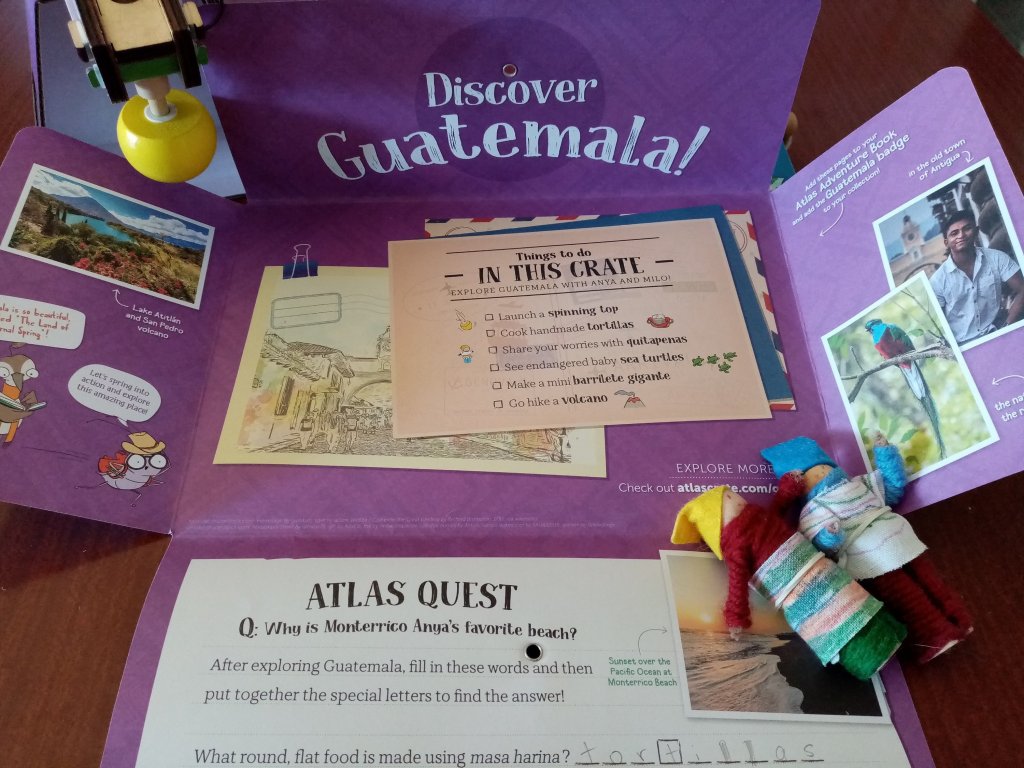
You begin by opening your travel mail from Milo and Anya to find out about their latest travel adventures! Miss 6 enjoys seeing all the photos in Guatemala.

There is a passport sticker to add to our Adventure Passport and various cards about Guatemala to add to it as well. These range from a country map and cultural information, to activity cards with things to do. Learn: some Spanish greetings and phrases; learn about the Quetzal as both a currency and the national bird, learn about Chichicastenango – one of the most beautifully colourful cemeteries in the world, and the turtles of Monterrico. We did a small study unit on turtles at the same time as learning about Guatemala 🙂

We ordered a book separately and chose Abuela’s Weave by Omar S. Castañeda. We also had a go at weaving on a mini loom that we were given.

Making a wooden spinning top

Our first craft was making a wooden spinning top with launcher. Trompos are popular in both Guatemala and Mexico and are launched from a standing position (check out this video); Atlas Crate make their’s easier for beginners by including a launcher.

Making a worry doll

These are inspired by Guatemalan Muñeca quitapena. Legend has it that a Mayan princess named Ixmucane received a special gift from the sun god of wisdom to solve any problems that worried humans. Children whisper their worries to the dolls and place them under their pillows at night; the dolls will hold their worries for them and hopefully the children will have a peaceful night’s sleep – waking with new insight and solutions for their concerns.

HOW DO I ORDER ATLAS CRATE?

This is not a paid review. I spent a lot of time searching the internet to find out more information about the Kiwi Crate and Atlas Crate boxes before deciding to try them and found the blog posts / photos that people shared were really useful!

If you would like to try Atlas Crate (or one of their other lines), you can receive 50% off your first box by clicking here.

What I like about the Atlas Crate kits is that they provide a colourful and imaginative way of exploring the world through hands-on activities. I like that they use a mix of STEM and art to explore different concepts and ideas. Their products are also very well made, with clear instructions, and kids feel a real sense of pride in what they accomplish with each box.

There’s no obligation to sign-up in an on-going capacity so it’s easy to tie them in with birthdays / Christmas; the boxes are quite compact so they also store easily in a cupboard for bringing them out on a rainy day. Other families will choose to sign up for a longer period (like a 3, 6, or 12 month cycle).

WHAT IS IN AN ATLAS CRATE?

Each Atlas Crate comes with a special airmail envelope from Anya the Cricket and Milo the Sandpiper revealing where they’ve been on their latest adventure. There is a special passport sticker for your child’s Atlas Adventure Book plus seven new pages to add about a new country (highlighting geography, customs, landmarks, history, and foods).

There are supplies for two activities (which might be a mix of art, STEM, and games) as well as suggestions for more DIY activities to try at home – from things to make, to things to bake!

If you choose the Deluxe option, then you will also receive a book that helps you explore that month’s destination. This upgrade is an additional USD$9.95 (approx. $15 NZD) and can impact shipping costs as well. Since we’re homeschooling, I decided that we’d try the Deluxe option for 6 months to see how useful we find it.

Interested in more homeschool box reviews?

Discover the World with ATLAS Crate

#1 Introducing the World

#2 Discover Japan

#3 Discover France

#4 Discover Madagascar

#5 Discover Colombia

#6 Discover England

#7 Discover Nepal

#8 Discover Guatemala

Explore STEM with Kiwi Crate

#1 Arcade Box (and the Claw!)

#2 The Amazing Animation Box (make your own 19th century movie with a Zoetrope!)

#3 The Mechanical Sweeper Box (make your own baleen whale!)

#4 The Disc Launchers Box (play games with physics!)

#5 Kaleidoscope Puzzles (explore symmetry and mirrors!)

#6 The Human Body

#7 The Science of Tension

#8 All about Surface Tension

#9 Learn about Stars and Constellations