KiwiCo Review: Kiwi Crate for 5-8 year olds – DISC LAUNCHERS

Creative homeschool STEM fun with the Kiwi Crate Disc Launchers box and learning about physics through play!

WHAT IS IN THE DISC LAUNCHER BOX?

The science for this box is learning about physics and inertia. What I love about KiwiCo is how engaging they make learning about physics and how easy they make it for kids to understand. The comic strip for this box features the regular characters having wagon races with their soft toys – when one of the wagons is stopped by a rock, the stuffed bunny goes flying! They learn that not only is inertia a resistance to a change in force – movement – but also that seat-belts are really important protective features.

The Explore magazine gives lots of fun ideas of ways to explore inertia at home – from attempting the ‘pull tablecloth from beneath a plate’ magic trick, to watching what happens when you stop your own wagon suddenly. We found that we could easily repeat the concepts in the comic strip by using Lego vehicles and mini-figures, or by putting little balls into one of our HotWheels that looks like a supermarket trolley.

The main engineering build for this crate is building a Disc Launcher (reminiscent of a clay bird launcher) and there are enough materials to build two of these. There are a heap of wooden discs to launch, and these can also be used for homeschool activities as counting, coins, and whale food.

The disc launcher comes with ideas for games – such as knocking down skittles (rainbow ones included) or playing a version of curling using the scoring mat (included).

The secondary project (art) is using your imagination to make things out of air dry clay (pack included). We used the three colours provided (red, yellow, blue) to make archways, a goalie, and lots of multi-coloured balls. We found that we could get cool multi-coloured swirling colours when lightly combining and a sort-of purple when they were really thoroughly mixed. Our creations then created a kind of obstacle course for the disc launcher. It’s worth noting that air dry clay starts as a very soft malleable material; after 24 hours drying it could readily be played with but was also still able to be changed into new forms. You may want to give it a full week to dry and harden (if the kids are willing to wait that long).

HOW DO I ORDER KIWI CRATE?

This is not a paid review. I spent a lot of time searching the internet to find out more information about the Kiwi Crate and Atlas Crate boxes before deciding to try them and found the blog posts / photos that people shared were really useful!

If you would like to try Kiwi Crate (or one of their other lines), you can receive 50% off your first box by clicking here.

What I like about the Kiwi Crate kits is that they use a combination of Science, Technology, Engineering, Arts, and Mathematics to explore a concept or idea. There’s no obligation to sign-up in an on-going capacity so it’s easy to tie them in with birthdays / Christmas; the boxes are quite compact so they also store easily in a cupboard for bringing them out on a rainy day. Mind you, this only works if you spot the package on the door-step first – children become quite adept at recognising the green Kiwi Crate box and screaming with delight at it’s arrival!

The boxes are sent randomly so there’s no way to know what will come in the future; however, you can log-in to your account at the start of each month to see what box has been selected. Your box history is kept which means that even if you cancel and then pick-up again the following year they can make sure that you aren’t sent repeats of boxes.

WHAT IS IN A KIWI CRATE?

The Kiwi Crate is aimed at ages 5-8 years. It comes with a copy of the Explore magazine which opens with a fun comic about Steve the Kiwi and his friends. [As a side note, these are made by an American company despite the use of our New Zealand native bird]. These comics are really approachable for younger kids and a great way of exploring the concepts being introduced in a relateable manner.

The Explore magazine provides a range of information on the topic, it might include some simple games or tricks to try at home, and provide ideas for additional crafts / activities using simple materials. It also has a sticker [unique to each box theme] to put on your Kiwi Crate chart.

The box also includes an instruction manual and the materials that you need to build the main craft. Generally, there are two activities to do – one that is more art related, and one that is more mechanical engineering. What makes the kits special, is how well crafted the engineering components are. They really are designed for the intended age group so that they can either build themselves or help assist an adult. There are handy visual images and checkpoints to make sure that things are aligned correctly. There is no super-bonding-fingers-together wood glue to use with these projects (which makes them great for highly sensory children); instead parts come with double sided tape finely engineered on so that you just need to remove the backing strip of paper.

Interested in more homeschool box reviews?

Discover the World with ATLAS Crate

#1 Introducing the World

#2 Discover Japan

Explore STEM with Kiwi Crate

#1 Arcade Box (and the Claw!)

#2 The Amazing Animation Box (make your own 19th century movie with a Zoetrope!)

#3 The Mechanical Sweeper Box (make your own baleen whale!)

#4 The Disc Launchers Box (play games with physics!)

#5 Kaleidoscope Puzzles (explore symmetry and mirrors!)

ExperisenseNZ

Exploring Maths through Art

Exploring Space through Art

KiwiCo Review: Kiwi Crate for 5-8 year olds -MECHANICAL SWEEPER

Creative homeschool STEM fun with the Kiwi Crate Mechanical Sweeper box and learning about baleen whales.

WHAT IS IN THE MECHANICAL SWEEPER CRATE?

This box is all about baleen whales! The main project (engineering) involves building a mechanical floor sweeper with it’s rotating foam ‘teeth’ representing the baleen ‘moustache’ found in the whale’s mouth for filtering krill out of water. What makes it really engaging for kids is the art aspect for the crate.

The second project (art) is creating two watercolour salt art whales. Everything you need is included (from a paint kit to the salt) and the kids can create beautiful textured patterns with salt while learning about molecular bonds. The salt attracts and absorbs the water around it but leaves the coloured pigments behind.

The whales are then attached to the sides of the floor sweeper and Voila! Your baleen whale can now eat the little furry balls (representing phytoplankton and zooplankton) provided with the crate.

There are also ideas included for additional projects using materials at home – like making a baby whale using a paper cup and craft materials.

HOW DO I ORDER KIWI CRATE?

This is not a paid review. I spent a lot of time searching the internet to find out more information about the Kiwi Crate and Atlas Crate boxes before deciding to try them and found the blog posts / photos that people shared were really useful!

If you would like to try Kiwi Crate (or one of their other lines), you can receive 50% off your first box by clicking here.

What I like about the Kiwi Crate kits is that they use a combination of Science, Technology, Engineering, Arts, and Mathematics to explore a concept or idea. There’s no obligation to sign-up in an on-going capacity so it’s easy to tie them in with birthdays / Christmas; the boxes are quite compact so they also store easily in a cupboard for bringing them out on a rainy day. Mind you, this only works if you spot the package on the door-step first – children become quite adept at recognising the green Kiwi Crate box and screaming with delight at it’s arrival!

The boxes are sent randomly so there’s no way to know what will come in the future; however, you can log-in to your account at the start of each month to see what box has been selected. Your box history is kept which means that even if you cancel and then pick-up again the following year they can make sure that you aren’t sent repeats of boxes.

WHAT IS IN A KIWI CRATE?

The Kiwi Crate is aimed at ages 5-8 years. It comes with a copy of the Explore magazine which opens with a fun comic about Steve the Kiwi and his friends. [As a side note, these are made by an American company despite the use of our New Zealand native bird]. These comics are really approachable for younger kids and a great way of exploring the concepts being introduced in a relateable manner.

The Explore magazine provides a range of information on the topic, it might include some simple games or tricks to try at home, and provide ideas for additional crafts / activities using simple materials. It also has a sticker [unique to each box theme] to put on your Kiwi Crate chart.

The box also includes an instruction manual and the materials that you need to build the main craft. Generally, there are two activities to do – one that is more art related, and one that is more mechanical engineering. What makes the kits special, is how well crafted the engineering components are. They really are designed for the intended age group so that they can either build themselves or help assist an adult. There are handy visual images and checkpoints to make sure that things are aligned correctly. There is no super-bonding-fingers-together wood glue to use with these projects (which makes them great for highly sensory children); instead parts come with double sided tape finely engineered on so that you just need to remove the backing strip of paper.

Interested in more homeschool box reviews?

Discover the World with ATLAS Crate

#1 Introducing the World

#2 Discover Japan

Explore STEM with Kiwi Crate

#1 Arcade Box (and the Claw!)

#2 The Amazing Animation Box (make your own 19th century movie with a Zoetrope!)

#3 The Mechanical Sweeper Box (make your own baleen whale!)

#4 The Disc Launchers Box (play games with physics!)

#5 Kaleidoscope Puzzles (explore symmetry and mirrors!)

ExperisenseNZ
Exploring Maths through Art

Exploring Space through Art

Life in Lockdown – Decorate our streets!

Making homemade chalk is easy a great way to connect as a family!

Life in New Zealand has changed rapidly. Our borders are closed, domestic travel restricted, our schools and shops closed, and we are asked to remain at home in order to restrict the spread of Covid-19. Cars are now to be used only for essential travel (the doctor, pharmacy, or supermarket) and people may only leave their house to walk nearby. Social distancing is everything.

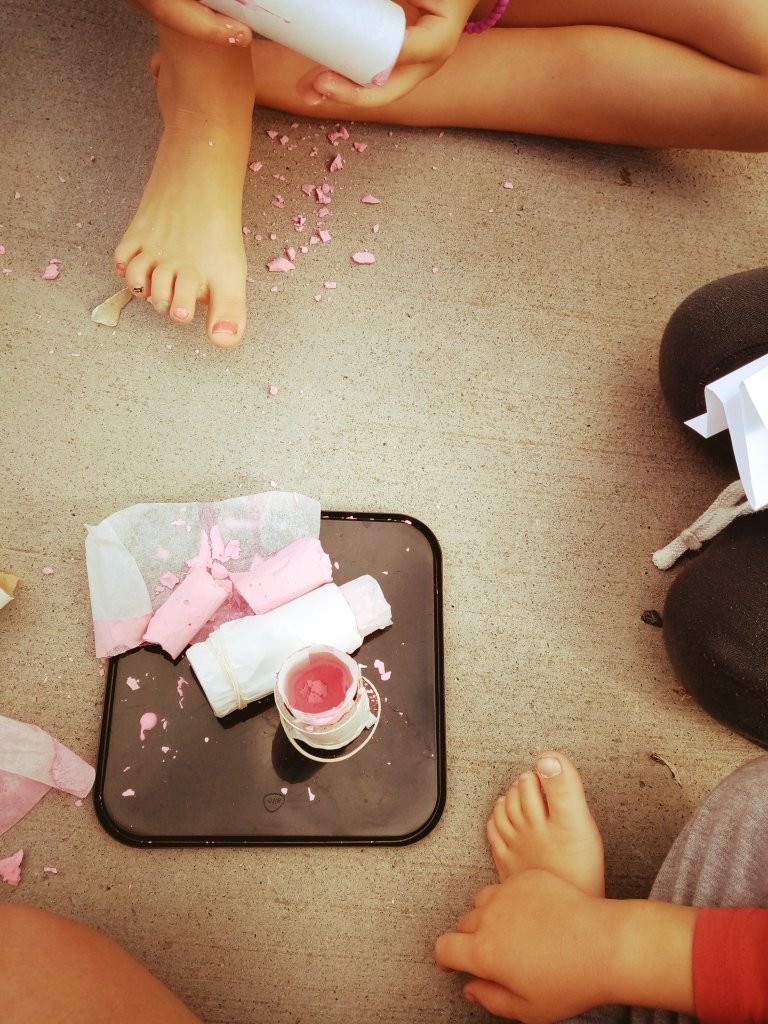
Our big field trip for today was walking to the top of the driveway and drawing pictures that the kids in the houses nearby can see from their windows. Creating chalk, with a few simple ingredients from the supermarket, has been both art and science. It’s also a way to share a little love and kindness with the community around us.

Why not bring a little colour to yours?

Life in lockdown: Share some love and decorate our streets!

How to make home made chalk

Ingredients

  • Cornflour
  • Water
  • Food colouring
  • Cardboard tubes
  • Waxed paper / baking paper
  • Scissors
  • Sellotape or rubber bands

Note: Alternative ingredients include plaster of paris + tempera paint, or a 1:2 ratio of very finely crushed eggshell + flour.

Directions

  1. Prepare your moulds. Toilet paper rolls are a good size; I find a bread knife does a good job of sawing longer cardboard inner tubes into parts.
  2. Cover the bottom of your cardboard tubes with waxed paper and tape / elastic band into place. You then want to roll more waxed paper and slot it inside (you may need to trim to size).
  3. Pour cornstarch into a bowl and then add food colouring of your choice. Slowly add water and mix well. You want to add just enough water to create a very thick [viscous] mixture.
  4. Pour or spoon the mix into your moulds.
  5. Pop into a hot water cupboard (or somewhere warm to dry). You want as much of the water to evaporate as possible to dry before use (about 24-48 hrs).
  6. You can then removed from the moulds and let the kids have fun!

Tip

If you add too much water then it will have difficulty drying (and remaining contained within the moulds). Never fear! Treat it as a chemistry and physics lesson all-in-one for the kids. You have just created a non-Newtonian fluid 🙂 You can take your ooblek outside for messy play fun with the kids. Pour it into your hands and watch how it becomes a solid if you clench your fist but magically liquefies if you release the pressure!

Easy Christmas Gifts for Kids to make

Upcycled tin cans can make all kinds of things!

Upcycling tin cans is a great way to get kids involved in Christmas gift giving (and it’s cheap!). They can be filled with craft projects, candy canes, coins, colouring pencils or pens, or seeds for the spring!

Whether you’re homeschooling, or just enjoy learning with the kids, it’s easy to integrate S.T.E.A.M. into this project. Skip to the end for ideas!

Materials

  • 420g tin can (15oz), empty, washed, and dried.
  • Scrapbooking paper
  • Measuring tape (dressmakers)
    • OR string.
  • Pencil
  • Ruler
  • PVA glue (white glue)
  • Scissors

Directions

  1. Prepare your tin can. Tip: Choose one where your can opener left smooth edges! Remove the old label (warm water can help).
  2. Select your scrapbooking paper.
  3. Use a flexible dressmakers tape to measure the circumference and height of your can (or a piece of string which you can lie against a ruler).
  4. Once you have your measurements, mark out a rectangle on your paper. I like to add several centimetres (an inch) to the length and height of what I’m going to cut out as this allows a margin of error and means you can do a pretty fold at the top.
  5. Wrap the paper around the tin can and make sure the pattern will align correctly with how you plan to orient the tin. When you’re ready do a vertical line of PVA glue (the residue of the old glue will give you an idea of how wide you want to spread your glue). Wrap the paper around and smooth it down. Add more glue where the end of the paper meets and overlaps the start of the paper.
  6. If you’ve allowed an overlap at the top, cut a vertical slit (to the metal edging) at the four compass points. Apply glue to the inside of the paper and then fold down smoothly into the can.
  7. Once the glue is dry, you can fill it with all kinds of things!

Learning through play

Maths

  • 3D Shapes: Cylinders can both stack and roll. Compare this with other 3D shapes like a sphere (ball) or a cube (dice).
  • Measurement: Curved surfaces can be more challenging to measure – we can use a flexible piece of string to wrap around the cylinder and then lie it flat against a ruler or piece of paper. The curved face of the cylinder will transform into a rectangle when it’s drawn.

Fine Motor Skills

School skills are being practised with cutting and gluing. A fun way to practice fine motor skills is to fill the finished can with pom-poms and then fish them out with mini-tongs.

Creativity

As well as choosing pretty scrapbooking paper, you could use a hot glue gun to add ribbons, lace, colourful buttons, and all kinds of things to your creation! Googly eyes and a marker pen make an easy face and then stand pipe cleaners / chenille sticks in the tin as hair.

Making Christmas Cards & Decorating Christmas Trees with Children

Christmas Tree Cards

Decorating Christmas Trees

Christmas Crafts for kids

I posted recently about making our own Christmas Crackers (bonbons). I also like making our own Christmas cards. It’s nice because it’s an activity in itself and you can theme it around your children’s skills / ages. Christmas stickers or stamps are good way place to start with toddlers; or save their paintings through the year and turn those into cards!

Christmas Tree cards

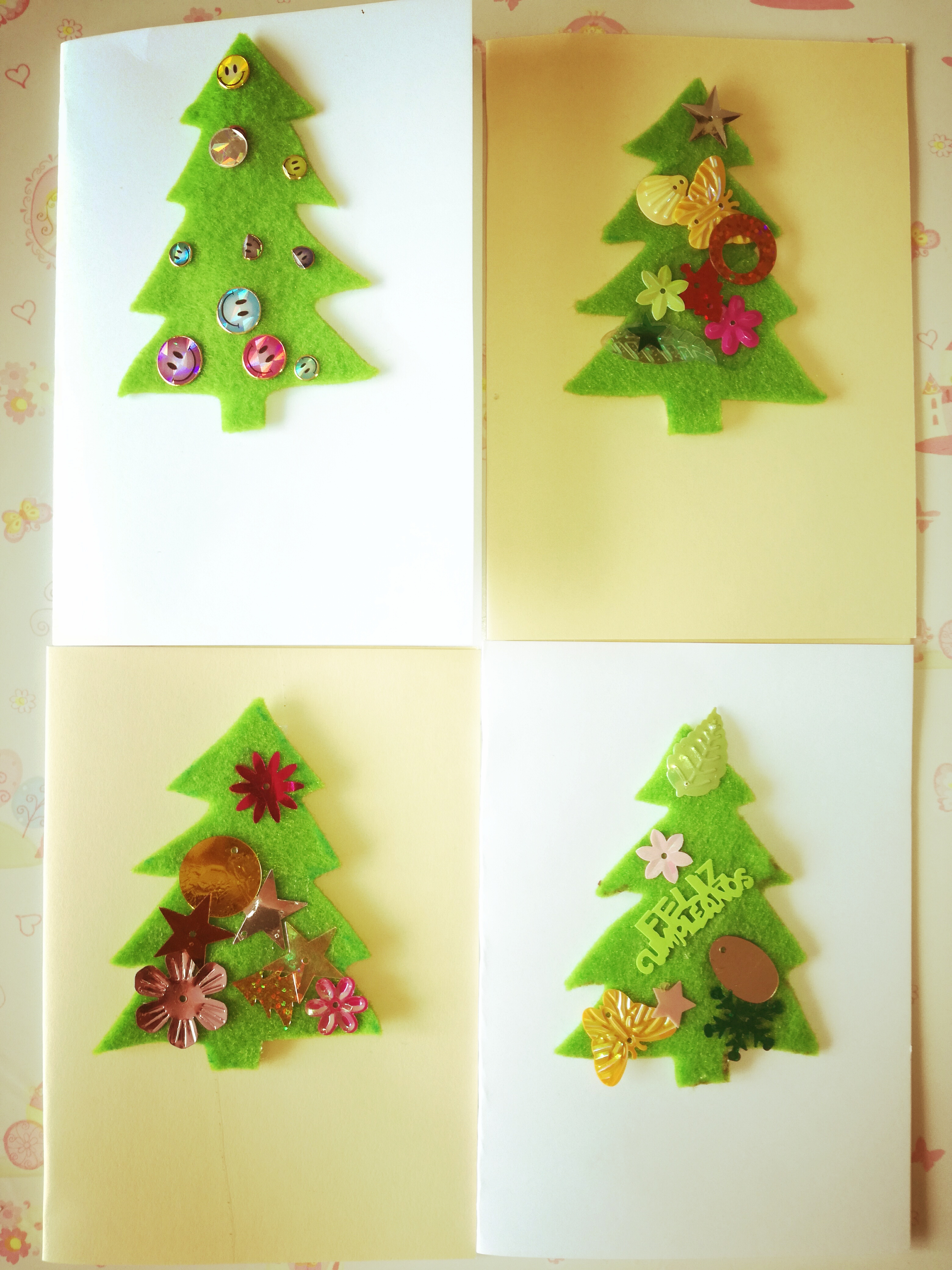
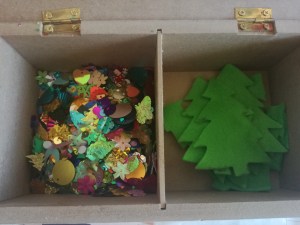
This year, I decided to print a Christmas tree template and trace around it on a sheet of green felt. I also picked up a shiny bag of beautiful decorations that included everything from stars, to shells, to butterflies, to Christmas greetings. I wanted to make Christmas tree cards that would let Miss 3 be creative and feel involved.

Christmas Tree cards

Christmas trees and decorations

Ingredients

  • Green felt
  • Stickers / glitter / craft shapes
  • Card stock / paper
  • Scissors
  • Craft Glue / P.V.A. / glue gun
  • Blu-tak
  • Baking paper
  • Double sided sticky foam squares (like for scrapbooking)

Directions

  1. Create a Christmas tree template on paper / cardboard. Trace around it on green felt and cut out all of the trees that you need. (An adult will need to do this for toddlers / preschoolers; older children may be able to do all of the steps themselves).
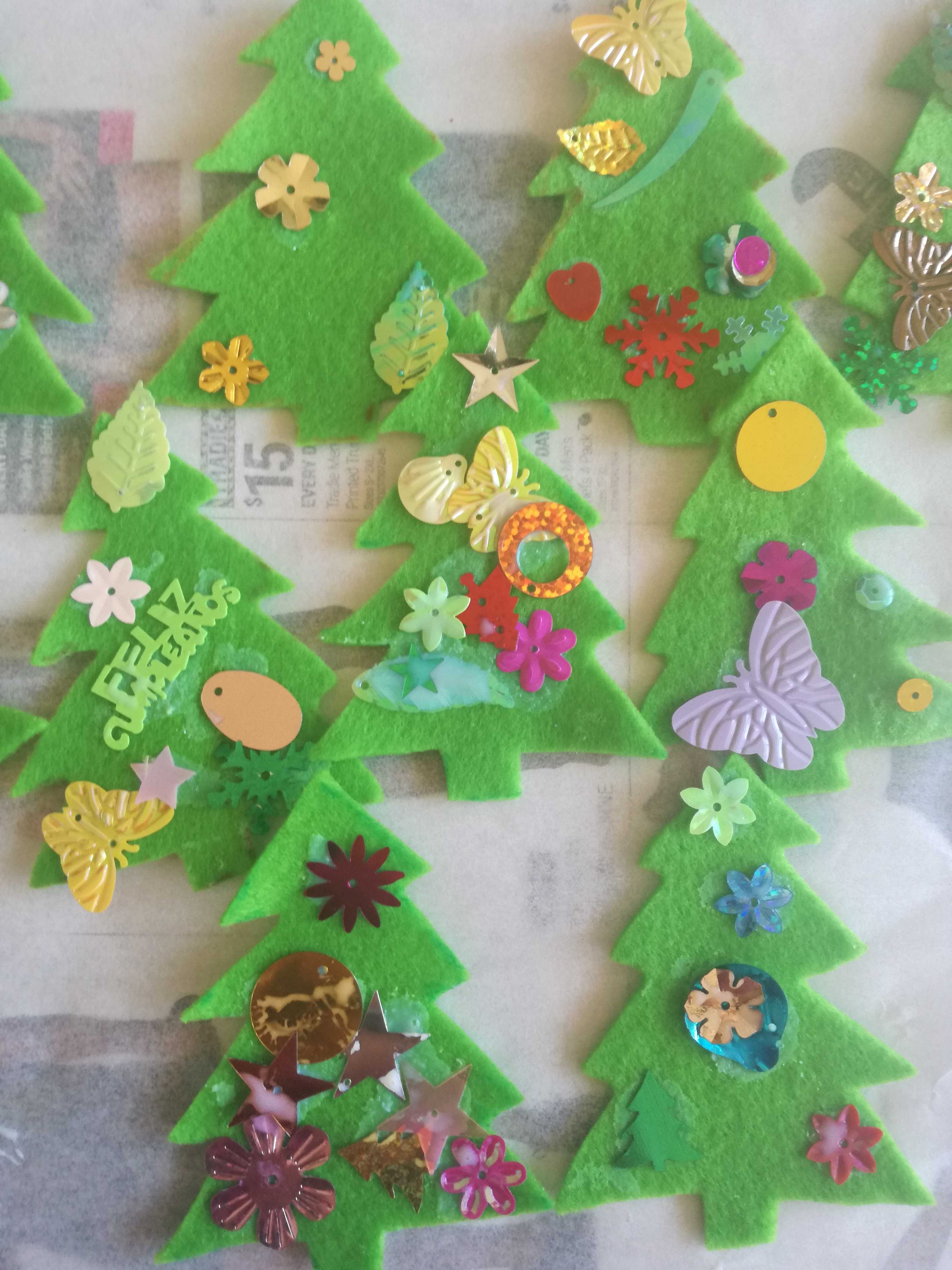
  2. Blu-tak the felt onto a large sheet of baking paper. This helps keep them in place while busy little hands decorate them and also raises them off the paper a little in case the glue soaks through.
  3. Glue the decorations onto the trees. Craft glue will need to set over night, whereas a glue gun has the advantage of setting almost immediately.
  4. Make plain cards by folding the card stock / paper. Once the glue is dry, use the double sided sticky foam squares to attach the trees to the cards. These have a nice effect as they raise the tree slightly and make the cards look a bit prettier but you can just as easily glue the trees on if you wish.
  5. Ta da! Now you have a beautiful collection of cards and each one is unique.

Decorating Christmas Trees

Decorations on Christmas Trees


Making Christmas Crackers (Bonbons)

How to make Christmas Crackers (Bonbons)

I posted last year about how easy it is to make your own Christmas Crackers (bonbons). I love that personalizing them means that you have full creative license to create different themes each year. Last year, we did a Christmas theme for the visual aesthetic and I hand decorated wooden beads (my daughter still has them!). This year I thought I would celebrate New Zealand’s summer with an ocean theme.

Ingredients 

  • Cracker snaps
  • Cardboard tubes (inner tubes from paper towels are perfect,  just cut in half).
  • Your choice of cracker filling.
  • Blue crepe paper
  • Shells
  • Twine
  • Sellotape
  • Scissors
  • Super glue (or glue gun)

Note: Davids Emporium  sells cracker snaps for 30 cents each just ask at the sales counter.

For the inside, I did little plastic bags containing: Christmas joke, stickers, and a miniature Christmas cookie / Christmas pudding etc. These will inevitably get gifted to the dollhouse 🙂  They are adorable and were a wonderful find in the button / crafts section, again at  Davids Emporium.

Directions

  1. Take a cracker snap and place it inside in your tube (it should stick out each end with a comfortable amount to pull on). Lightly sellotape it at each end to hold in place.
  2. Assemble your cracker filling and slide it into the tube. I put mine in a tiny sealed plastic bag.
  3. Roll the tube in crepe paper and tie at each end with twine;  make sure that you have enough paper at each end to cover the cracker snap that is sticking out & to comfortably pull it.  Super glue (or glue gun) on the sea shells.

Rainy day play: Making a spider

Easy to make spider

Make a simple spider!

Kids love playing with craft materials. Why not spend a rainy afternoon making spiders, insects, or monsters; you could tie it in with a trip to the library to find some books for inspiration!

Materials

  • Pipe cleaners
  • Milk bottle lid
  • Googly eyes
  • Sellotape
  • Craft glue / glue gun
  • Scissors


Directions

  1. Cut your pipe cleaners to length and sellotape (or glue gun) them to the base of the milk bottle lid. Bend them to give them knees / feet so that it can stand.
  2. Glue on some googly eyes.
  3. Take the spider exploring!


Why not share with them 20 Fun Facts about Spiders for preschoolers or watch a short educational video clip about spiders aimed at preschoolers and kids.

How to make an easy and cheap instrument at playgroup (Musical Maracas)

Making musical maracas

Making musical maracas

Making musical maracas

Making musical maracas

What you need

  • Paper plates (small).
  • Felts, crayons, paint, stickers etc.
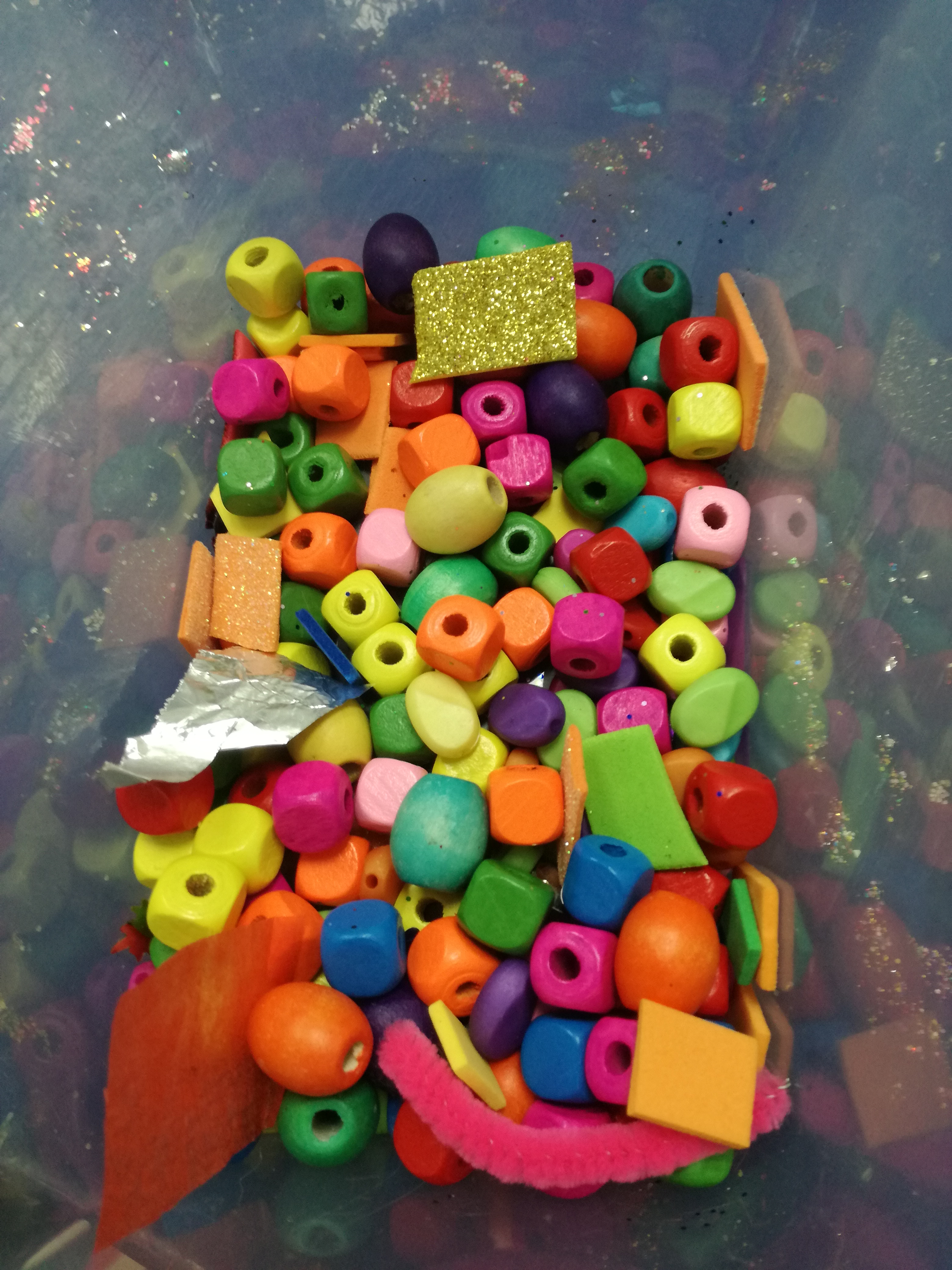
  • Wooden beads, sea shells, bells etc.
  • Stapler.

Directions

  1. Help your children to decorate the outside of the plates (don’t forget to write their names on!).
  2. Fold the plate in half (like an empanada) and staple along the edges. Leave a gap at the top.
  3. Hold it upright with the gap at the top. Help your children to drop beads, bells, shells etc. inside their musical instrument; one big toddler sized handful will be about enough.
  4. Staple up the gap, put on some music, and shake!

Note: This is a great activity to do on a rainy day or with a playgroup. For younger toddlers choose larger items to put inside and play with under supervision only; i.e. keep choking hazards in mind.

Rainy day play: Make a fishing game!

Make an indoor fishing game!

Make an indoor fishing game!

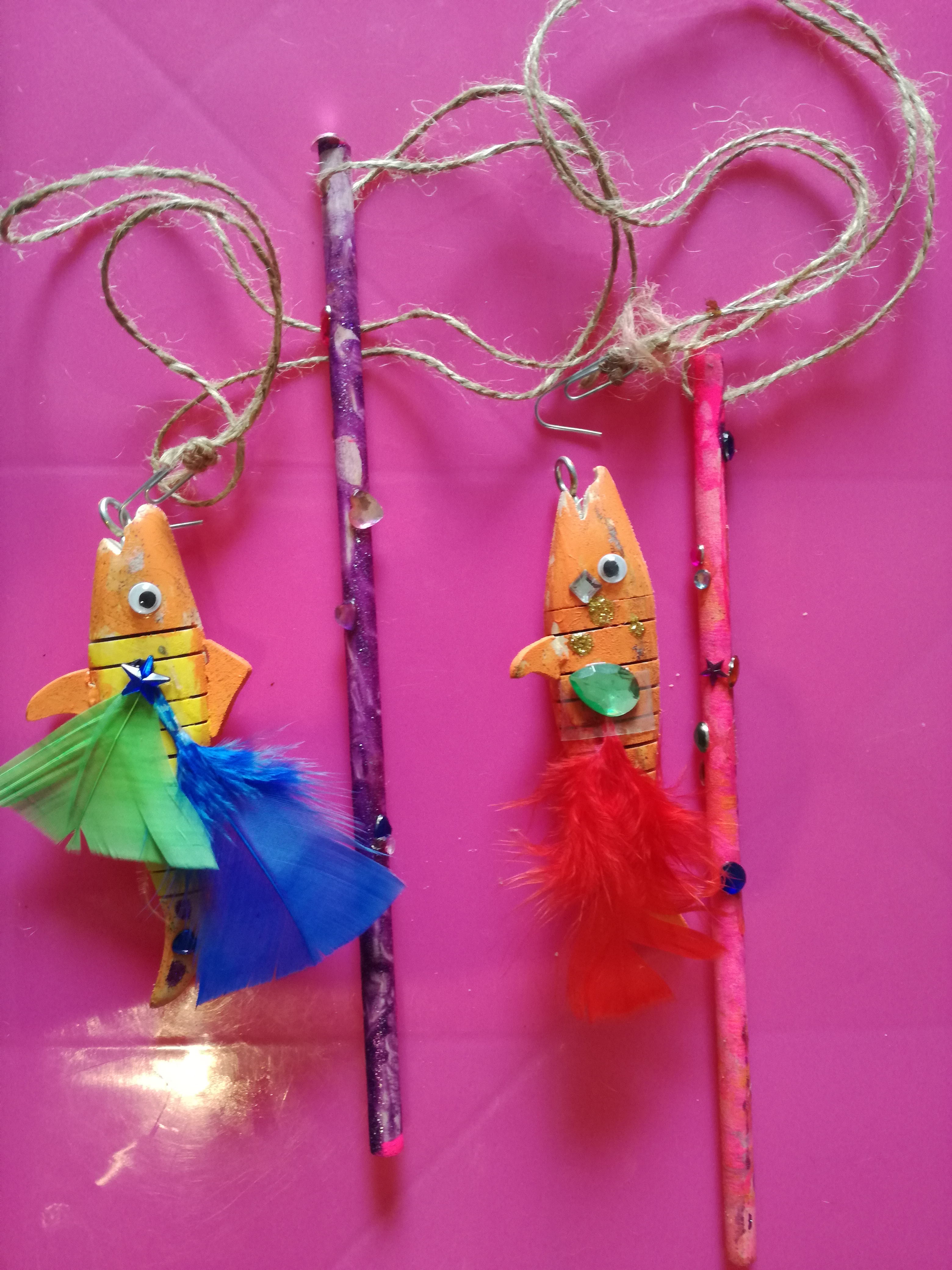
Indoor fishing can be a great way to develop fine motor skills and imaginative play! You can buy fully stocked Gone Fishing kits or you can make your own. We picked up our fish very cheaply (as they were factory seconds) and then let our imaginations run wild with the materials we had at home.

The Fish

We were fortunate enough to pick up our fish cheaply. You could also use a saw or sandpaper and glue gun to fashion a vague fish shape from scraps of wood. The metal eyelet is the same as what’s used when stringing up net curtain cords.

We decorated our fish with: several colours of paint, glitter glue, googly eyes, coloured feathers, and plastic gems.

Tip: This is a great craft project for teaching your toddler patience. We worked on ours over about 5 days. We needed to do the base colour on one side and then let it dry overnight; flip it over the next day and repeat the same. You need more time to let things dry when you’re using craft glue but can speed things up by using a glue gun.

The Fishing Rods

You can make these with lengths of dowling. Use an electric drill to make a hole about 1cm from the top and thread some twine through that has a paper clip tied to the other end. Alternatively, you could glue gun the twine to the rod (if you don’t have a drill).

The paper clip is surprisingly effective; I can catch my fish with it and Miss 2 will normally ‘manually’ catch her fish but will also attempt to catch it without ‘helping’ the hook.

Our rods have multiple shades of paint and glitter glue on them (as well as plastic gems) and also needed drying each night in the hot water cupboard. I stood them upright in a small glass baby food jar (we have several that we use for crafts).

Learning to sew

A step by step beginner's guide to sewing

A step by step beginner’s guide to sewing

I recently gained access to a sewing machine. My previous experiences were the 10 lessons we did as a class, decades ago, when I was in Intermediate School. My Nana was a dressmaker and money is tight so I’d love to learn a new skill.

I decided my best approach, since I don’t have a mentor, was to look through the local library. I found a brilliant book by Jane Bull, My Sewing Machine. It’s a step-by-step guide for beginners, ostensibly for 8-12 year olds since it was in the children’s section, with lots of photos and easy projects. It explains the different parts of the sewing machine and how to thread it.

Setting up the sewing machine probably seems really simple if you’re familiar with one but it’s not intuitive for me. There are a lot of steps, compared to hand sewing, and forgetting one of them leads to catastrophe! (Not really, but it can cause a lot of frustration as the needle just tattoos holes in the fabric or the threads turn into a tangled cat’s ball).

The sewing machine is located at our lovely new kindy. I had a pair of fascinated 4 year olds avidly watching my every step (no pressure!). It’s actually a nice learning experience for the kids being able to talk to them about how I don’t know how to use it and that we can work it out together. It’s not just about teaching them how to sew, it’s teaching them the process of learning. I’m talking with them about going to the library, following the instructions in the book, and asking for help when I can’t work out something myself.

Thankfully, one of the student teachers is a sewer; I’ve been able to run to her for help a few times when everything’s turned to custard!