Through the Desert – Boardgame Review

Through the Desert – caravan leaders

From the award-winning game designer Reiner Knizia comes a game of strategy, patience, and cool plastic camels! The desert is still treacherous, mysterious, and without mercy. But for those willing to risk the dangers of the shifting, sun-baked sands, the desert holds riches beyond compare.
In Through the Desert, two to five players each control a tribe of nomads vying for control of the desert. By establishing caravans and taking over oases, the players gain points as their tribes increase in power.

Strategy is essential in deciding how and where to build your tribe’s caravans. There are multiple ways to gain points and several ways to win. Should you try to build the longest caravan? Or should you dominate the desert’s oases? Don’t forget to keep an eye on your opponents’ caravans, or you may find your own tribe cut off from valuable water holes.

Through the Desert (a strategy / placement game)

Many reviewers have found the game reminiscent of the ancient and elegant game of Go. Through the Desert can be played in a number of strategic ways (including encapsulating territory and aiming to prevent your opponents from reaching key resources) but at it’s heart it’s about camels. 180 beautifully coloured miniature camels in five pastel colours (along with caravan leaders) that are sure to delight younger players (and are still pretty cool as an adult).

Players take turns to place their leaders on the board and then game play proceeds by choosing two camels (of any colour) and placing them on the board (connecting them to your caravan(s) of the same colour. Play continues until there are no camels left of a particular colour.

Strategy comes into play with the various placement rules and scoring system. You can place camels of a different coloured caravan next to your opponents camels but not next to the same colour (an important rule as otherwise camel ownership would become very confusing!). This simple rule opens up all kinds of strategic moves as you work to block opponents from reaching their goals.

Scoring involves reaching the five palm-tree oasis, taking watering holes, capturing territory (by surrounding it), and having the longest caravans of each colour.

Bonus features

There are rules provided for how to scaffold the game from 2 players to 5 players; the beautiful game board also provides natural geographic features to restrict the play area if there are only 2 players. It’s also double sided so that once you have mastered ‘the mountain’, you flip it to see how ‘the river’ changes play.

It also provides optional rules for variant game plays.

What age is the game suitable for?

To an extent, this will depend on the children involved and their interests / attention span. It helps that the rules are simple enough that even younger children can simply choose camels (at random or based on their favourite colour) and join in – while also adding an element of natural chaos to the plans of older players.

Slightly older children will begin to understand there are different possible goals and begin to engage with these. They may choose to focus on a single goal at a time or juggle a multiple focus. Goals can include:

  • Having the most camels of a particular colour on the board.
  • Linking their caravans to as many oasis as possible (each caravan scores 5 points for each oasis they reach).
  • Acquiring as many watering holes as possible (these score points and are removed from the board by the player that reaches them first).
  • Creating lines to stop other players from moving forward / reaching their goal.

Adults will appreciate that last goal often isn’t the most high-scoring but it’s a tactic that kids will delight in when they thwart their parents!

What can boardgames teach us? a.k.a. learning through play

There’s a whole community of homeschoolers who focus on gameschooling as a key way of learning. Why? Because it makes learning fun and there are so many wonderful games out there that can teach kids skills and knowledge without them even being aware that they’re learning.

In Through the Desert, they are learning:

  • Maths: strategy; logical reasoning.
  • Maths: counting to 20, addition, skip counting, and equivalency trading.
    • Even if they don’t instinctively recognise that 5+5 = 10, they can quickly learn that they can trade 2 x 5 point tokens, for a 10 point token with a different picture.
    • Children can help to score at end of game by: counting how many camels they have of each colour; ‘skip counting’ by 5’s or 10’s to add their oasis points; add their 1 / 2 / 3 point watering hole tokens together to find a total.
  • Visual-spatial recognition and reasoning.
    • By end of game there is a beautiful and unique pattern of coloured camels on the board (with complexity increased by number of players) so there is a fair amount of visual processing involved in working out final scoring – especially for minor captured territories (encapsulation).
  • World Studies:
    • It’s a great opportunity to review any desert habitats or countries that you’ve studied. We pulled out our range of desert dwelling animals that we’ve collected in our studies so far to watch the action; unsurprisingly, our Dromedary Camel was lead judge.
  • Life Skills:
    • It’s a great game to discuss short-term gains (such as thwarting parents) vs long-term gains (strategic scoring).
  • Social Skills: turn taking, patience, and good sportsmanship.
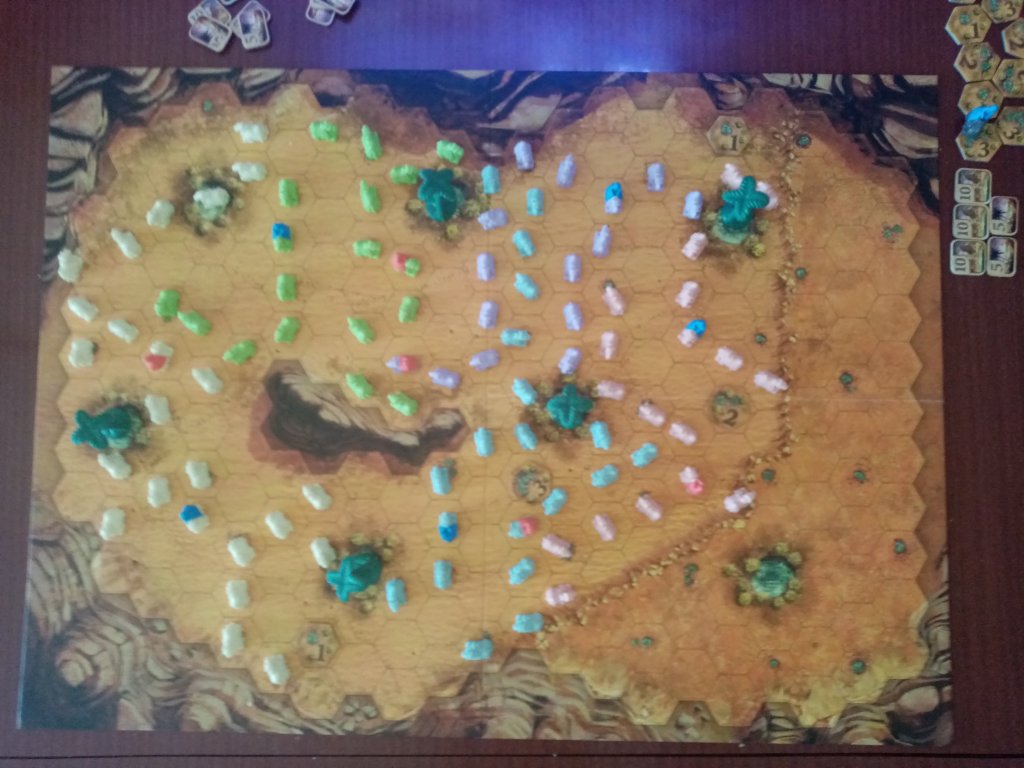
Through the Desert end of game

Writing with phonics: Short vowel ‘a’.

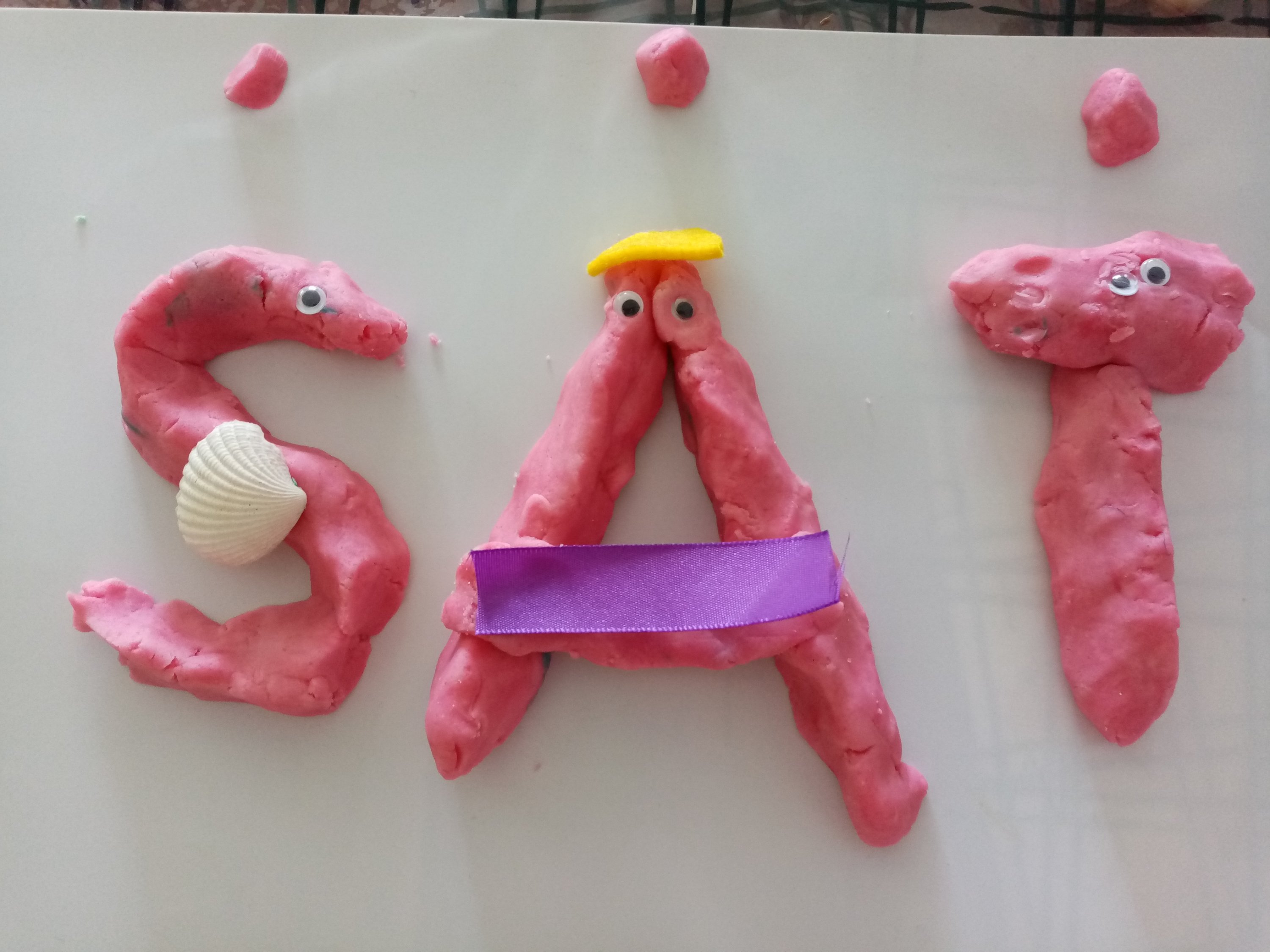
SAT (short vowel ‘a’)

Today’s word is brought to you by Miss 5 and the colour pink!

Learning to read and spell with phonics

Classrooms around the world take all kinds of different approaches to learning to read, write, and spell. In New Zealand, research studies (McNeill & Kirk, 2014) found that most teachers did not teach their students phonemes, how to spell phonologically, sound-letter relationships, or spelling patterns. Understanding how to decode language is especially important for children with special learning needs, such as dyslexia and auditory processing disorder, as they require an explicit understanding of these topics (exposure to print media and general literacy is not enough to create an implicit understanding or ‘osmosis’ effect).

It is important to teach a phonological awareness of each alphabet sound (what ‘sound’ does the letter make). A good place to start can be putting a light coating of shaving foam in a flat tray and tracing the upper case letter with your finger while making the accompanying sound. After modelling, encourage the student to make 3-5 attempts. Speculate together what words might start with that sound. Tip: If dyslexia is indicated or they are struggling to distinguish letters, focus on capital letters as these are easier to differentiate visually.

When moving onto words, a good place to start is with short vowel ‘a’ as several phonics words families can be taught together. It’s common to start with CVC words [consonant-vowel-consonant].

When teaching an explicit awareness of phonemic awareness, ‘SAT’ is composed of: 3 letters, 1 syllable, and 3 phonemes. Within the -at phonically decodable word family are multiple words that have the same onset-rime.

Syllable: A unit of sequential speech sounds containing a vowel and any consonants preceding or following that vowel. (Henry, 2010. p.314)

Phoneme: The smallest unit of sound that conveys a distinction in meaning. (Henry, 2010, p.312).

Onset-rime: The onset is the initial consonant or consonants within a syllable. The rime is the vowel and any consonant that follows, within the syllable. (Nicholson & Dymock, 2015.p.87)

-at words

  • cat
  • fat
  • sat
  • hat
  • mat
  • rat
  • bat

-an words

  • can
  • fan
  • man
  • ran
  • van
  • tan
  • pan

-ap words

  • tap
  • cap
  • gap
  • lap
  • nap
  • map
  • zap

-am words

  • jam
  • ham
  • Sam

High frequency words

  • a
  • can
  • and
  • I
  • see

Activities to try

Playdough letters

Make or buy laminated upper case letter mats. Ask the student to help you make each of the letters needed to make one of the CVC words above. While making the letter, explain that there is a sound that matches the letter and model making it,

When the word is complete, show how to sound out the letters to make the word.

Silly Spelling

Using toys, containers, or pictures drawn on paper, create a ‘treasure chest’ for real words and a ‘rubbish bin’ for fake words.

Use 3D letters to make one of the words above; let’s use CAT as an example. Demonstrate how to sound out the letters. Ask the student if they think it is a real word or fake word. Write CAT on a strip of paper and place it in the treasure chest.

Ask the student to remove the first sound [C] and swap it for a different one. Let’s say they add ‘L’. Ask the student if they think LAT is a real word or fake word. Write LAT on a strip of paper and place it in the rubbish bin.

Explicitly discuss how the end sound (-at) is staying the same and ask if they can think of any words that rhyme with CAT. Demonstrate with another word such as HAT.

Jumbled Words

For some learners, it can be difficult to focus on ‘flat’ worksheets and working with kinaesthetic 3D letters can be more helpful. If the entire alphabet is placed in front of them and they are asked to spell RAT this may be visually overwhelming. Try scaffolding the activity:

Level 1: Have the word (and a picture) on a card in front of you. Model spelling the word with the 3D letters and sounding out each letter. Point out that you are matching the letters with the order on the card.

Level 2: Place on the letters that are needed in front of you. Explain to the student that you were trying to write [MAT] but the letters got muddled. Sound out the letters in the word and ask the student if they can put the letters in the right order to match the sounds.

Level 3: Place five letters in front of you. Advise the student that you feel they know the word [MAT] so you have a game that is a little harder. Explain that three of the letters are needed to spell the word and two of the letters are tricks. Sound out the letters in the word and ask the student if they can put the letters in the right order to match the sounds.

You might find that they identify the correct letters but place them in the wrong order. Praise them for finding the right letters and help place them in the correct order. Teach them that there is a pattern that they can learn for this phonic word family. Show them how the -at words they have been learning all have -at at the end and only change the beginning letter.

Phonics Strips

Create your own sliding phonics strips. These are a great visual activity for showing how changing a phoneme can alter the word.

Phoneme Boxes

Show students how to chunk words into their individual phonemes by using phoneme boxes. Explicitly discuss the difference between the number of letters that a word has and the number of sounds that a word has.

Students are likely to begin with CVC words where there are three letters and three sounds. The English language is full of all kinds of oddities (with its blend of Anglo-Saxon, Romance languages, and Greek roots). They will go on to encounter words like M|OO|N which has 4 letters / 3 phonemes; or CL|O|CK which has 5 letters / 3 phonemes.

It can be helpful to pick up a visual phoneme chart that shows all 44 sounds of spoken English and gives examples of their use.