KiwiCo Review: Kiwi Crate for 5-8 year olds – Maps and Treasure Chests!

WHAT IS IN THE TREASURE HUNT BOX?

What do Treasure Hunts have to do with maths you ask? Maps and co-ordinates are a fun part of maths! The Explore magazine teaches kids how to read a map (including what a compass rose is and how to read a legend). They then get to have a go at making their own!

Kiwi Crate’s Treasure Hunt box comes with materials for three crafts:

DESIGN AND MAKE A TREASURE CHEST

Clear instructions and no wood glue required made this a delightfully age appropriate build! The treasure chest is not only nicely on theme for the topic but has also proved popular since for open-ended play. I will note that we had no success picking the lock so decided to set it aside before the keys inevitably got lost.

DESIGN AND EMBOSS GOLDEN COINS

Every treasure chest needs treasure! This was a fun open-choice activity that allows kids to design each face of three coins. There are a range of numbers and kiwis provided. Kids place their choices on the coins, add a golden sticker, and carefully smooth them until the bas-relief is visible.

MAKE YOUR OWN TREASURE MAP

There are lots of different paper options provided for making your own maps. a good place to start is to map a room / house / garden and see if someone can find where the treasure chest has been hidden. Another good map to make is how to walk or drive to some place that you go often like school, a park, or a library.

More Mapping Activities

National Geographic have lots of mapping activities that can be done at home! They provide the teaching ideas, images, and PDFs that can be downloaded. Check out:

We are Teachers have lots of hands-on ideas with photographic inspiration: check them out here.

Some fun boardgames that teach reading grid co-ordinates include Peaceable Kingdom’s Race to the Treasure and the classic game Battleships.

HOW DO I ORDER KIWI CRATE?

This is not a paid review. I spent a lot of time searching the internet to find out more information about the Kiwi Crate and Atlas Crate boxes before deciding to try them and found the blog posts / photos that people shared were really useful!

If you would like to try Kiwi Crate (or one of their other lines), you can receive 50% off your first box by clicking here.

What I like about the Kiwi Crate kits is that they use a combination of Science, Technology, Engineering, Arts, and Mathematics to explore a concept or idea. There’s no obligation to sign-up in an on-going capacity so it’s easy to tie them in with birthdays / Christmas; the boxes are quite compact so they also store easily in a cupboard for bringing them out on a rainy day. Mind you, this only works if you spot the package on the door-step first – children become quite adept at recognising the green Kiwi Crate box and screaming with delight at it’s arrival!

The boxes are sent randomly so there’s no way to know what will come in the future; however, you can log-in to your account at the start of each month to see what box has been selected. Your box history is kept which means that even if you cancel and then pick-up again the following year they can make sure that you aren’t sent repeats of boxes.

WHAT IS IN A KIWI CRATE?

The Kiwi Crate is aimed at ages 5-8 years. It comes with a copy of the Explore magazine which opens with a fun comic about Steve the Kiwi and his friends. [As a side note, these are made by an American company despite the use of our New Zealand native bird]. These comics are really approachable for younger kids and a great way of exploring the concepts being introduced in a relateable manner.

The Explore magazine provides a range of information on the topic, it might include some simple games or tricks to try at home, and provide ideas for additional crafts / activities using simple materials. It also has a sticker [unique to each box theme] to put on your Kiwi Crate chart.

The box also includes an instruction manual and the materials that you need to build the main craft. Generally, there are two activities to do – one that is more art related, and one that is more mechanical engineering. What makes the kits special, is how well crafted the engineering components are. They really are designed for the intended age group so that they can either build themselves or help assist an adult. There are handy visual images and checkpoints to make sure that things are aligned correctly. There is no super-bonding-fingers-together wood glue to use with these projects (which makes them great for highly sensory children); instead parts come with double sided tape finely engineered on so that you just need to remove the backing strip of paper.

Interested in more homeschool box reviews?

Discover the World with ATLAS Crate

#1 Introducing the World

#2 Discover Japan

#3 Discover France

#4 Discover Madagascar

#5 Discover Colombia

#6 Discover England

#7 Discover Nepal

#8 Discover Guatemala

#9 Discover Greece

Explore STEM with Kiwi Crate

#1 Arcade Box (and the Claw!)

#2 The Amazing Animation Box (make your own 19th century movie with a Zoetrope!)

#3 The Mechanical Sweeper Box (make your own baleen whale!)

#4 The Disc Launchers Box (play games with physics!)

#5 Kaleidoscope Puzzles (explore symmetry and mirrors!)

#6 The Human Body

#7 The Science of Tension

#8 All about Surface Tension

#9 Learn about Stars and Constellations

Fun math games for kids – Sum Swamp

Learning Resources: Sum Swamp

Sum Swamp is a maths boardgame that practices addition and subtraction in a simple and colourful way. What I like about the game is that it is very appealing to visual-kinaesthetic learners. Children select one of the four colourful markers (frog, snail, dragonfly, or crocodile) and roll dice to create equations that determine how they move around the board. The full instructions are conveniently available to view online: here.

The game is aimed at ages 5+ and can be played by 2 – 4 players; younger children may prefer to play two characters in case one languishes far behind the rest. Children are learning to arrange sums so that the largest number goes to the left; to recognise plus (+) and minus (-) symbols; and to recognise odds and evens. The simplest addition sum in the game is 1 + 1 = ?; the most difficult addition sum in the game is 6 + 6 = ?.

Tips for scaffolding the game (decreasing difficulty)

  • You can make the game easier by using physical objects for children to count and re-group while they do the sums.
  • The game provides numeral dice; consider switching to dice with dots. This helps children by giving them something visual to count.
  • Provide a number line. There are various types that can be purchased or you could print one for free from Twinkl.

Tips for scaffolding the game (increasing difficulty)

  • Buy a write on / wipe off dice (or other blank dice) so that you can also use the game to practice multiplication and division.
  • Buy a set of beautiful gaming dice containing D4, D6, D8, D10, D10 percentile, D12, and D20 (check out colours like milkshake, undersea whispers, or supernova). This opens the game up to an older audience; for instance, you can do equations up to 20 (using D12 + D8) and up to 30 (using D20 + D10). You may need to come up with a few house rules as you move to bigger numbers; for instance: that you need to do two laps of the board to finish, or, that the maximum amount you can move forward/back in a turn is 10.

Fun math games for kids – Times Tables Heroes

Orchard Toys: Times Tables Heroes

Before we played Times Tables Heroes, we had already spent time looking at the concept of ‘grouping’ (multiplication) and ‘skip counting’. We ‘group’ our captured pieces when we play Fanorona and I show how we can count them by 1’s, or 2’s, etc; we collect pebbles on our nature walks and practice different ways to ‘group’ them to help us count them. Times Tables Heroes is a fun way of practising our times tables that Miss 6 genuinely enjoys (and much better than my memories of sitting in front of a chalk board while the entire class repeated after the teacher!).

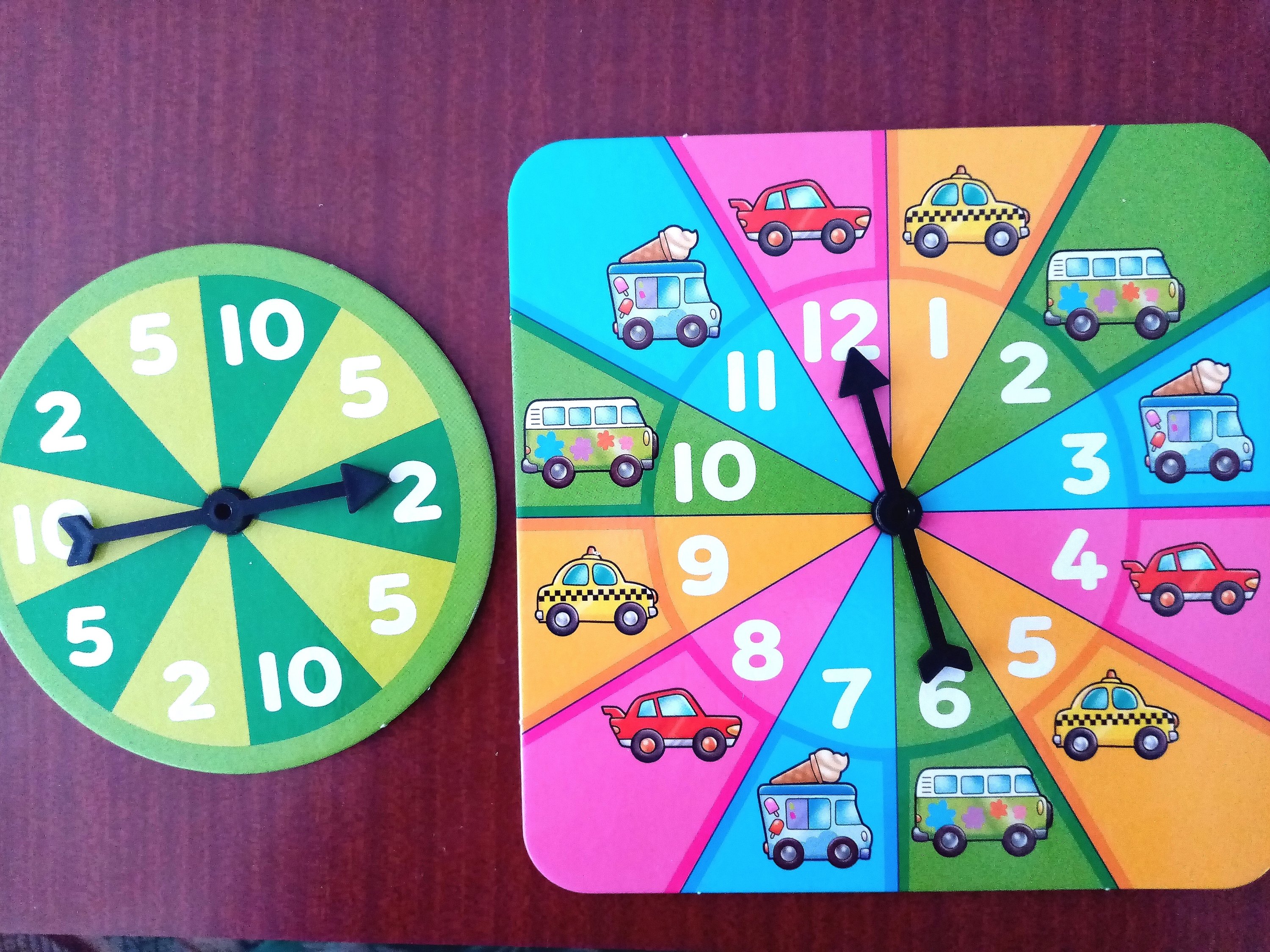
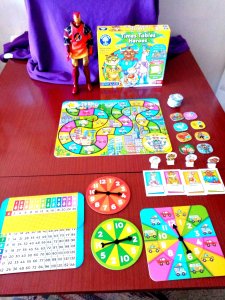
The game comes with sturdy cardboard pieces and is easy to set-up. You choose from one of four superheroes (each of whom has unique super powers). Instead of rolling a dice, you spin two spinners. One spinner determines which multiplication table you will practice; beginner level practices 2, 5, 10 and advanced level practices 1 – 12. The next spinner determines how many ‘groups’ you will have; i.e. 12 groups of 2. Once you have announced the answer correctly, you move to the next vehicle on the board that matches the spinner.

I love that the game comes with a colourful multiplication slider. It’s easy to scaffold the game so that children begin by using the slider to find their answer and then, as they gain confidence, to check their answer. We also do a hand-clapping singing game to work our way through the times tables each time to reach the answer.

The twist for the game is that it also incorporates oral storytelling (a literacy bonus!). If you land on a vehicle with a shield then you pick up a dreadful disaster card and need to describe how you will use your superpowers to save the city. The game helpfully comes with a guide that explains the disasters but we prefer to make up our own, after all – would you rather defend the city from an asteroid, or from an attack by giant flaming meatballs from an alien’s intergalactic BBQ party?

Tip: What is wonderful for visual-spatial learners and kids whose learning needs mean they need lots of movement, is that they do not need to sit still for this game. Encourage them to get up and act out their story (or everyone’s story – though they may need to be encouraged to do silent mime on other people’s turn).

Tip: It’s easy for this game to tick off maths, oral storytelling, and drama in a single session. You could use it to further support literacy, by asking kids to later extend on one of their superhero stories by writing it down / typing it up. Alternatively, encourage them to dictate the story and focus on linear story telling, mind mapping what / when / why / who / where, and editing.

Tip: The Shield cards have numbers that provide bonus moves. We find the game quite short so we ignore this and our house rule is to treat these as victory points; this way everyone can have a go at defeating the robot at the end of the board and it doesn’t matter who gets there first.

Maths Bingo

You can also reverse the game board to create maths bingo boards (with extra boards available online).